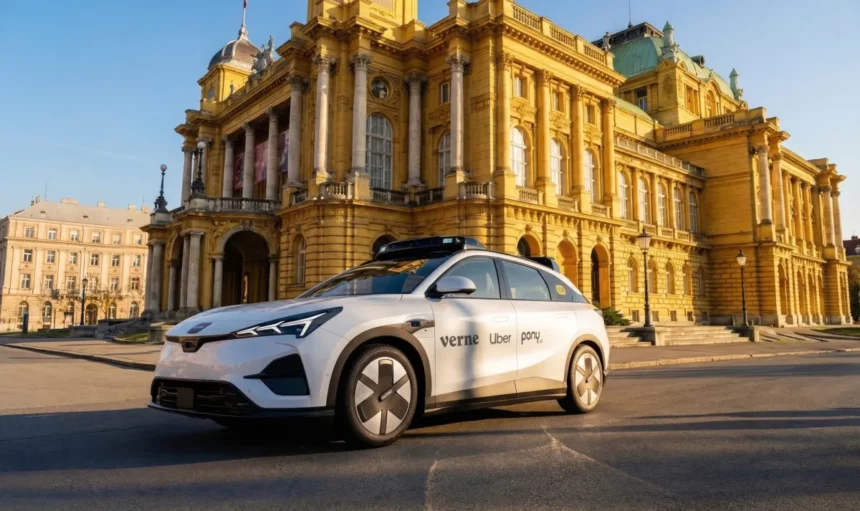
Europe’s robotaxi ambitions have long remained in cautious experimentation, constrained by regulation and unclear economics. What is now emerging in Zagreb suggests a shift toward real commercialization. Observers following the sector, including those tracking developments through NewsTrackerToday, increasingly see this as a potential inflection point rather than another pilot.
The partnership between Uber, Pony.ai and Verne is structured with clear intent. Pony.ai provides a mature autonomous driving system, Verne manages fleet operations and infrastructure, while Uber delivers demand through its global platform. This setup directly targets the industry’s main weakness – turning technology into a repeatable service. Uber’s investment signals a long-term positioning strategy aimed at staying central in a driverless mobility economy.
Zagreb as a launch city reflects a calculated approach. It offers regulatory flexibility, proximity to Rimac Group, and a manageable urban environment compared to larger European capitals. This allows companies to refine operations, safety protocols, and user experience before scaling. Analysts referenced in NewsTrackerToday have consistently highlighted that phased deployment is more viable in Europe than aggressive expansion.
Verne’s background supports the idea of a structured, long-term project. Originating from Project 3 Mobility within Rimac Group, the company has secured significant funding, developed multiple prototypes, and is preparing production capacity. Still, success will depend on operational performance – ride frequency, safety metrics, and cost efficiency – rather than capital alone.
A key strategic decision is Verne’s initial use of Pony.ai-powered Arcfox Alpha T5 vehicles instead of its own designs. This prioritizes speed and reliability over differentiation. Many competitors have struggled by trying to build every component simultaneously. Verne’s approach reflects execution discipline. Sophie Leclerc, technology sector commentator, would likely describe this as a shift from concept-driven development to operational focus.
Pony.ai’s involvement adds both opportunity and risk. The company is expanding globally, positioning itself as a supplier of autonomous systems. This accelerates Europe’s deployment but increases reliance on external technology. Isabella Moretti, corporate strategy and M&A analyst, might view this as part of a broader trend where European mobility projects depend on international partnerships to remain competitive.
Regulation remains the defining factor. Despite existing EU frameworks, real-world deployment still faces legal and operational barriers. Zagreb effectively becomes a test case: success could accelerate approvals across Europe, while failure may reinforce caution. This regulatory dimension, as often highlighted in NewsTrackerToday, may shape the sector more than technological readiness itself.
Uber’s role is strategically significant. Instead of developing autonomous technology, it positions itself as the demand layer of future mobility. This preserves its relevance regardless of which systems dominate. Verne gains immediate market access, while Pony.ai enters Europe through an established platform. Each partner compensates for its limitations, creating a more resilient model.
The broader implication lies in scalability. If Verne moves from testing to consistent commercial operations, similar models are likely to appear in other mid-sized European cities before expanding further. The key indicators will be paid ride volumes, regulatory speed, and cost control at scale. Ultimately, this is not just a localized launch but an attempt to define a workable template for autonomous mobility in Europe – one that continues to be closely analyzed across platforms like News Tracker Today as the market searches for its first truly repeatable model.