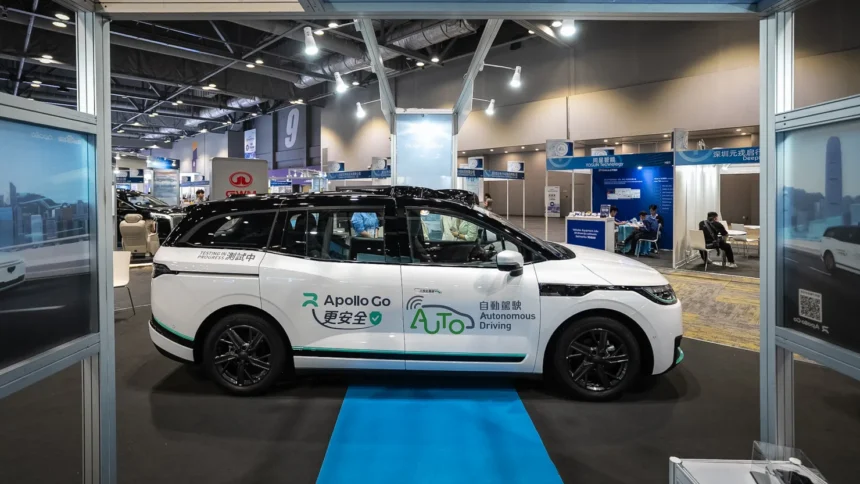
The robotaxi industry has long positioned itself as an inevitable future of urban mobility, but real validation happens not in presentations, but on live city streets. The recent Apollo Go incident in Wuhan represents exactly that kind of test. As we observe at NewsTrackerToday, the issue is not simply that a failure occurred, but that it happened at scale within one of the most mature and visible autonomous fleets in China.
Authorities confirmed that multiple Apollo Go vehicles stopped in the middle of the road due to a system malfunction. Passengers exited safely, and no serious injuries were reported. However, videos circulating online showed blocked traffic lanes and minor collisions. The key takeaway is structural: when a failure affects multiple vehicles simultaneously, it exposes systemic vulnerability rather than isolated error. This matters because Apollo Go is no longer an experimental deployment. The platform has already reached millions of fully driverless rides and operates at high weekly volumes. That level of scale changes expectations. Investors and regulators no longer evaluate whether the technology works in principle – they evaluate whether it can operate reliably under continuous, real-world pressure.
Wuhan plays a central role in this story. With more than 1,000 driverless vehicles, it represents Apollo Go’s largest and most symbolic deployment. Isabella Moretti, analyst specializing in corporate strategy and M&A, would likely describe this as a flagship exposure risk, where a failure in a key market carries disproportionate reputational impact compared to smaller pilot regions. At the same time, Apollo Go is expanding internationally. The company has launched fully autonomous services in the Middle East and is forming partnerships to integrate its technology into global ride-hailing ecosystems. As NewsTrackerToday points out, this changes the stakes entirely. Local technical failures now influence global perception, especially in markets where regulators and partners are still evaluating the reliability of autonomous systems.
Competition further intensifies the situation. Baidu faces pressure from domestic players such as WeRide and Pony.ai, while global comparisons inevitably involve Waymo. Incidents affecting fleets are not unique to China, but interpretation differs. In more transparent markets, operators typically provide detailed explanations of failures. In less transparent environments, uncertainty itself becomes a reputational risk. This creates an additional burden: companies must not only fix issues, but also clearly communicate them.
Transparency is becoming a defining factor for the sector. Apollo Go highlights its extensive autonomous mileage and lack of severe incidents, but large-scale disruptions introduce a different dimension of risk. Sophie Leclerc, technology sector commentator, would likely argue that the industry is entering a phase where it must prove not only that systems function correctly, but that they fail safely and predictably when disruptions occur. Regulatory dynamics are also evolving. As autonomous mobility expands, authorities are developing insurance frameworks and operational standards tailored to driverless vehicles. We at NewsTrackerToday see this as a transition toward institutionalization of the sector, where growth depends not only on technology, but on compliance, accountability, and risk management.
From an operational standpoint, Baidu now faces three immediate priorities. It must clearly explain the technical root cause of the failure, demonstrate that emergency protocols function effectively, and reassure international partners that such incidents do not undermine the platform’s reliability. Daniel Wu, expert in geopolitics and energy, would likely emphasize that export credibility has become a strategic factor, particularly as autonomous systems expand into new global markets.
In the broader context, this incident does not invalidate the progress of robotaxi technology, but it highlights the next barrier to scale. Growth will not depend solely on fleet size, mileage, or geographic expansion. It will depend on whether platforms can maintain trust under failure conditions. As we emphasize at News Tracker Today, the real competition in autonomous mobility is shifting from technological capability to operational resilience and public confidence.