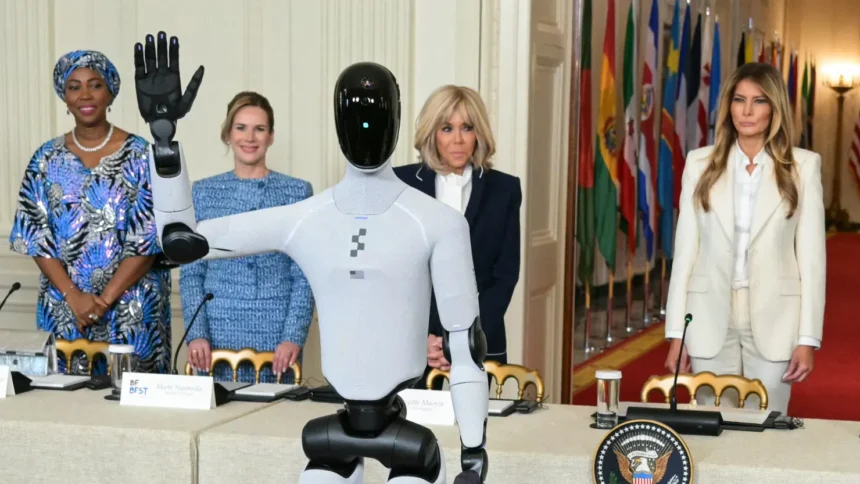
Humanoid robots have long been treated as high-impact demonstrations – impressive, but limited in real-world use. That perception is beginning to change. The appearance of Figure 03 at the White House alongside Melania Trump was not just a symbolic moment, but a signal that embodied AI is moving into the realm of national priorities. From the perspective of NewsTrackerToday, the key takeaway is clear: humanoid robotics is rapidly becoming part of the strategic competition between the United States and China.
Presenting Figure 03 in a political setting significantly elevates Figure AI’s positioning. The robot greeted attendees in multiple languages and participated in discussions about the future of education. This goes beyond a simple demo – it acts as institutional validation. When technologies appear in such environments, they shift from experimental concepts to candidates for broader societal integration. In analysis featured across NewsTrackerToday, similar moves are increasingly interpreted as early-stage normalization of robotics within public life.
The emphasis on education adds a strategic dimension. Framing humanoid robots as potential assistants for children creates a more accessible and socially acceptable narrative. However, it also introduces deeper concerns around trust, safety, and long-term behavioral impact. Sophie Leclerc, technology sector commentator, would likely view this as a familiar pattern: technologies are first positioned as helpful tools, only later forcing society to define their limits.
Figure AI’s rapid rise reinforces the scale of expectations. Founded in 2022 by Brett Adcock, the company has already secured over $1 billion in funding, reaching a valuation close to $39 billion. This reflects strong investor confidence, but also highlights the speculative nature of the sector. Such valuations are built on future potential rather than current revenue. In practical terms, the company now faces pressure to convert technological promise into real deployment at scale.
At the core of its strategy is Helix, a vision-language-action model designed to allow robots to perceive, interpret, and act in real time. This marks a shift from rigid automation toward adaptive systems capable of functioning in dynamic environments. The distinction is critical. If reliability can be maintained outside controlled settings, humanoid robots could evolve into a general-purpose platform rather than a niche solution.
Commercial execution remains the decisive factor. Figure has already begun working with BMW, deploying robots in manufacturing environments for tasks such as handling components. These use cases provide measurable indicators of performance and efficiency. Liam Anderson, financial markets specialist, would likely argue that such deployments – rather than high-profile appearances – will define the company’s long-term valuation. This aligns with the broader editorial view of NewsTrackerToday, where operational traction is seen as the true benchmark of technological maturity.
At the same time, the company faces ongoing scrutiny around safety. A lawsuit from a former head of product safety raises concerns about the physical capabilities of the robots and potential risks. Figure AI disputes these claims, but the situation highlights a broader issue. Unlike software-based AI, humanoid systems operate in physical environments, where failures carry direct consequences. Without clear safety standards, scaling into homes and public spaces may face resistance.
This tension between rapid innovation and unresolved risk defines the current stage of the industry. Political endorsement may accelerate adoption, but it also increases expectations for accountability. If companies fail to establish credible safety frameworks, regulatory intervention is likely to follow.
Another important dimension is leadership. Brett Adcock’s background in building companies at the intersection of hardware, AI, and mobility reflects a broader shift in the U.S. tech ecosystem. Founders are increasingly aligning their ventures with national strategic narratives, particularly around technological competition. As reflected in ongoing coverage by NewsTrackerToday, this intersection between private innovation and public policy is becoming a key driver of both valuation and volatility.
The future of humanoid robotics will depend on three core factors: safety, cost efficiency, and reliability in real-world conditions. Demand is expected to grow across manufacturing, logistics, and eventually domestic use, but adoption will be shaped by how quickly these challenges are addressed. Investors should focus on deployment metrics, while regulators must balance innovation with public safety.
In this context, the White House appearance of Figure 03 is not just a milestone event, but an early attempt to position humanoid robotics as the next major platform in AI. Whether that vision holds will depend on execution rather than ambition – a dynamic that continues to be closely tracked in the evolving coverage landscape of News Tracker Today.