The world’s largest memory chipmaker just ran out of runway. On Wednesday, government-mediated talks between Samsung Electronics and its biggest labor union collapsed after a marathon 17-hour session at South Korea’s National Labor Relations Commission, clearing the path for an 18-day work stoppage beginning May 21. The shares took notice fast – Seoul-listed stock dropped as much as 6.1% on the news.
The union represents more than 47,000 employees and centers its demands on a clear set of numbers: performance bonuses equal to 15% of operating profit, elimination of existing payout caps, and a formalized bonus clause embedded in employment contracts. NewsTrackerToday flagged this standoff weeks before it hit the financial headlines, tracking the widening gap between record AI-era revenues and the bonus structures workers say haven’t kept pace. Samsung countered with a one-time payment for 2026 and a flexible incentive structure tied to either 10% of operating profit or economic value added – a formula the union rejected outright. Both sides agreed to two rounds of mediation, the second running from May 18. Neither round closed the gap.
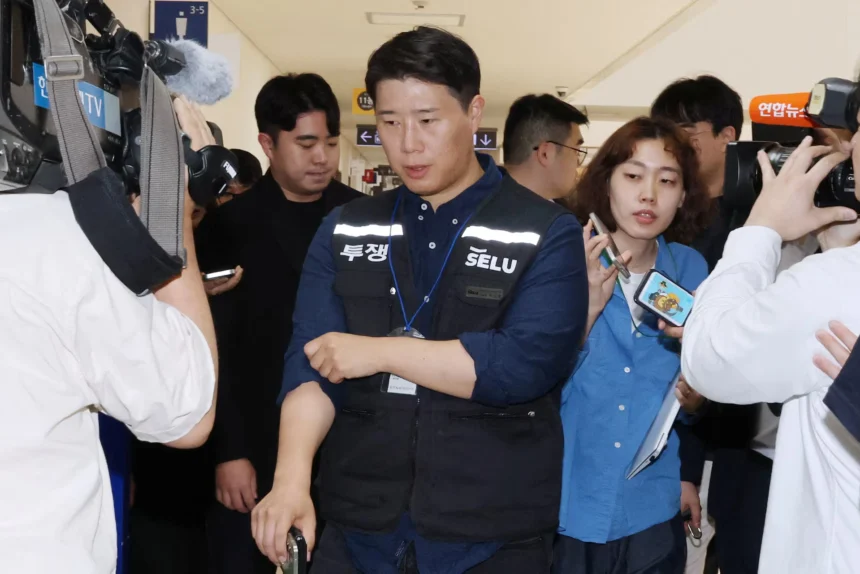
The math behind the anger isn’t hard to follow. Samsung posted record semiconductor earnings as AI demand supercharged memory prices, particularly for high-bandwidth memory. Workers watched the revenue charts climb. The bonus pool stayed capped. Union spokesperson Choi Seung-ho told reporters at the Commission office that management had not meaningfully responded to demands, and that no further negotiations are planned before the strike date. Samsung’s company statement pushed back, arguing that accepting the union’s demands “could undermine the fundamental principles of company management,” while simultaneously insisting “there must be no strikes under any circumstances.” That’s a hard line to hold once the gates open Thursday morning.
NewsTrackerToday mapped out what a full 18-day stoppage actually costs in real numbers. Professor Song Heon-jae of the University of Seoul projects losses of roughly 1 trillion Korean won – approximately $700 million – per day from factory shutdowns. JPMorgan estimates the total revenue hit at over 4 trillion won, around 1% of Samsung’s entire semiconductor division’s annual sales. The union’s own estimate runs far higher, at up to 30 trillion won in total damages across the value chain. South Korean industry observers put potential economy-wide losses at up to 100 trillion won if the stoppage drags the full 18 days and triggers downstream supply disruptions. Liam Anderson, financial markets analyst, put it bluntly: “Samsung is betting workers blink first. With that daily burn rate, management has maybe four days before the calculus shifts entirely.”
Isabella Moretti, who tracks corporate strategy and M&A, framed the downstream risk: “The real exposure isn’t the lost output – it’s customer diversification. If hyperscalers start qualifying SK Hynix inventory as a primary source rather than a backup, Samsung loses pricing leverage it won’t recover quickly. You’re looking at a structural renegotiation of supply contracts, not just a one-quarter earnings hit.” NewsTrackerToday also documented the regulatory dimension. President Lee Jae-myung posted publicly that corporate management rights deserve respect alongside labor rights. Under Korean law, the Ministry of Labor can issue emergency arbitration orders suspending strike action for 30 days if national economic impact is deemed severe. Prime Minister Kim Min-seok already convened an emergency ministerial meeting after the first round of talks failed. Whether that statutory power gets deployed before Thursday is the single variable that changes the entire outcome.
Stack this up against the broader semiconductor picture. AI accelerator demand is straining capacity across the board, and a significant production disruption at the world’s top memory maker lands directly in the supply chains of every major server vendor and hyperscaler. News Tracker Today zeroed in on that systemic exposure: this dispute doesn’t just affect Samsung’s quarterly numbers. It potentially reprices memory supply contracts across the industry for the second half of 2026. Watch the SK Hynix order books. That’s where the pressure shows up first.