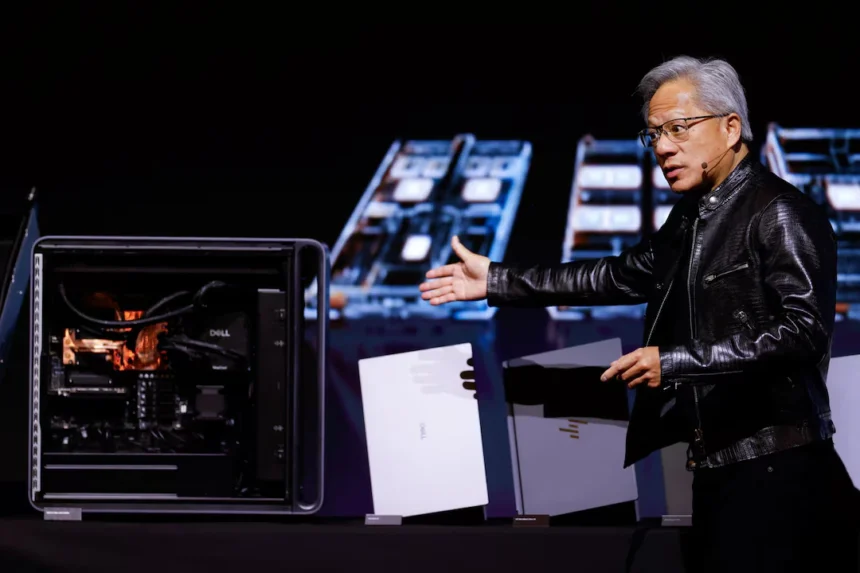
The $5 trillion chip company has a talking-points challenge that is also, honestly, a good problem to have. At Computex in Taipei on Tuesday, Nvidia CEO Jensen Huang told reporters at a GTC press conference that the company has enough supply to achieve very robust growth for both CPUs and GPUs, while simultaneously acknowledging that supply constraints still exist. Both statements are accurate. Reconciling them – as NewsTrackerToday traced through the full sequence of Computex announcements – requires understanding what kind of constraint Huang is actually managing – and why the supply chain answer is more specific than the general phrase supply constrained implies.
The constraint is not silicon fabrication. It is advanced packaging. The binding limit is TSMC’s CoWoS technology, the process integrating GPU and CPU dies with high-bandwidth memory into a unified module. Without CoWoS, a perfectly manufactured 3nm wafer cannot become a functional AI accelerator. TSMC is scaling CoWoS output from roughly 35,000 wafers per month in late 2024 toward a projected 120,000 to 140,000 wafers per month by the end of 2026 – nearly a fourfold increase in under two years. Despite that expansion, demand continues to outpace available capacity. TSMC’s CEO confirmed CoWoS remains sold out through 2025 and into 2026.
Vera Rubin, Nvidia’s next-generation AI platform, adds pressure to an already strained line. Huang confirmed it entered full production earlier in 2026 – a ramp that NewsTrackerToday documented as the largest product launch in Taiwan’s industrial history. The Vera Rubin supply chain is roughly twice the size of the preceding Grace Blackwell platform. Assembly time per rack dropped from two hours to five minutes. That throughput gain still cannot fully absorb order volume. Nvidia’s Q1 FY2027 results reported $81.6 billion in revenue, up 85% year on year, with Data Center revenue at $75.2 billion. Total supply-related balance sheet commitments stand at $95.2 billion. The demand is still larger than the supply chain that serves it.
Liam Anderson read the setup directly: “When a CEO says supply is constrained but sufficient for robust growth, he is saying demand is growing faster than supply and they are managing allocation. That is not a problem statement. It is a pricing statement. And it tells you that customers who need supply will pay the premium to secure it, which is exactly the position Nvidia wants to be in heading into a year where hyperscaler capex budgets are still expanding.”
Sophie Leclerc added structural texture, in an analysis NewsTrackerToday highlighted for the competitive implications it carries: “Nvidia has built a vertically integrated logistics operation for AI factories – securing memory, wafers, CoWoS capacity, cables, and systems simultaneously. Very few companies can manage that supply chain complexity at scale. The constraint advantages Nvidia, because smaller competitors cannot reliably fulfill large infrastructure orders. Scarcity, as Huang himself observed, pushes customers toward the highest-performing option they can actually obtain.”
Huang also announced RTX Spark, Nvidia’s first PC-based superchip developed with Microsoft for laptops and desktops. N2X and N3X successor chips are already under development. The company committed to returning at least 50% of free cash flow to shareholders in 2026, and announced plans to invest approximately $150 billion annually in Taiwan – the epicentre of the AI revolution, as Huang put it. Nvidia is now the largest buyer across Taiwan’s entire industrial ecosystem, from TSMC wafers to memory suppliers to packaging vendors.
What to watch through the rest of 2026: CoWoS capacity utilization data from TSMC’s quarterly earnings – metrics News Tracker Today captured as the single most reliable leading indicator for Nvidia’s revenue ceiling -, Vera Rubin rack deployment rates at major hyperscalers, and any signal from the U.S. trade environment about whether advanced AI chip export restrictions to China are modified under ongoing bilateral negotiations. Nvidia’s next quarterly results will tell us whether the $95.2 billion in supply commitments it has made against its balance sheet is translating into revenue recognition at the pace the guidance implies. Jensen Huang has described this moment as the largest infrastructure expansion in human history. The supply data will show how close to that claim the reality runs.