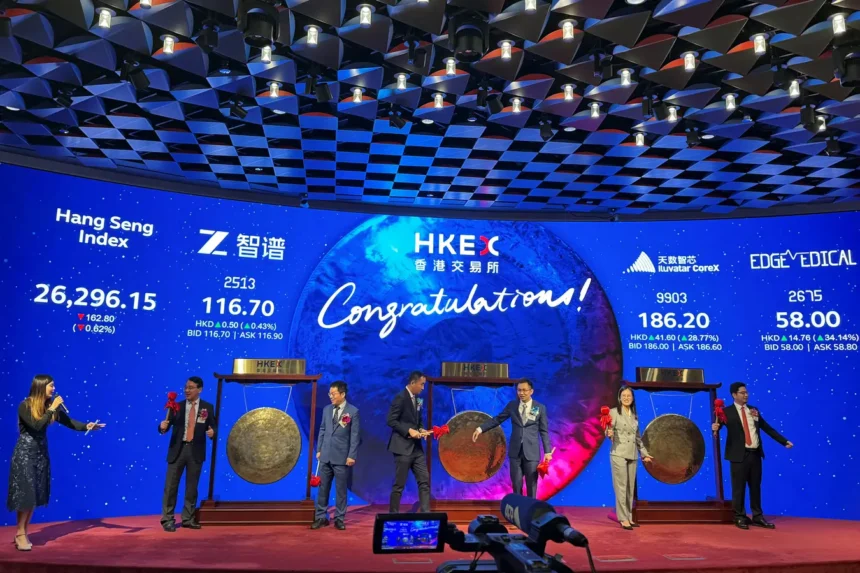
The world’s first publicly traded large language model company just announced it wants to go public again. On Monday, Knowledge Atlas Technology JSC – better known as Zhipu AI, now rebranded as Z.ai – said it intends to apply for a domestic listing on Shanghai’s Sci-Tech Innovation Board, the STAR Market. The proposed A-share issuance covers between 2% and 8% of total share capital, or 9.1 million to 38.8 million shares at a nominal value of 0.10 yuan each. The company did not disclose a fundraising target – a gap that NewsTrackerToday examined in the context of its previous disclosures. That omission is informative.
Zhipu’s Hong Kong listing on January 8, 2026, was already a landmark. The company raised $558 million at HK$116.20 per share, with retail investors oversubscribing the offering 1,159 times. By late May 2026, Zhipu’s Hong Kong market capitalization exceeded HK$700 billion – roughly $89 billion – a near-tenfold gain from IPO price in five months. The financial reality behind that trajectory is stark: Zhipu’s R&D expenses in 2024 reached 2.195 billion yuan, more than seven times its revenue for that year. In the first half of 2025, R&D spending consumed over 800% of revenue. Computing power service fees alone accounted for 70% of total R&D costs. The company reported massive net losses in the billions of yuan for both 2024 and the first half of 2025.
The STAR Market listing is a direct response to that burn rate. A-shares in Shanghai historically trade at valuation premiums over Hong Kong H-shares, unlocking access to mainland Chinese retail and institutional investors who represent a deeper domestic capital pool. The A+H dual structure – listing on both exchanges simultaneously – is something NewsTrackerToday pulled to the front as the defining capital strategy for China’s AI model sector in 2026. MiniMax signed a tutoring agreement with CITIC Securities on May 29 to begin its own STAR Market process, following Zhipu’s February appointment of Guotai Haitong Securities and CICC as joint sponsors. Two unprofitable AI companies that both listed in Hong Kong in January are now racing to double their capital formation channels on the same domestic exchange within the same year.
Daniel Wu placed the strategy in regional context: “China’s approach to AI capital formation mirrors what it did with semiconductor policy after 2018 – accelerate domestic listing mechanisms to reduce dependence on foreign capital markets and build homegrown valuation benchmarks. Zhipu pursuing dual listings in the same year is part of that architecture. The timing is not incidental.”
Sophie Leclerc added the competitive framing, in a read that NewsTrackerToday established as the sharpest structural challenge facing Zhipu’s domestic listing ambitions: “The R&D-to-revenue ratio at Zhipu is extreme by conventional metrics, but it mirrors the OpenAI model – and investors have demonstrated they will fund that profile if the model capability curve is convincing enough. What Zhipu needs from the STAR Market is not only capital. It is domestic institutional legitimacy in front of Chinese enterprise procurement teams who still weight domestic listing status in vendor selection decisions.”
The broader signal the dual listing strategy sends is worth documenting. MiniMax’s Hong Kong stock rose over 400% from its January IPO, reaching a market cap of HK$263.5 billion. Both Zhipu and MiniMax remain unprofitable and are expanding through sovereign AI partnerships across Southeast Asia, the Middle East, and Europe. The pattern is consistent: Chinese AI firms are building capital structures designed for a decade-long race, not a near-term profitability milestone.
What to watch: the CSRC review timeline, whether the 2% to 8% share issuance range is revised upward in the final prospectus, and how Chinese state-owned enterprise customers respond to the dual listing as a procurement signal. Zhipu’s model capability trajectory – particularly the GLM series and the commercial traction of GLM Coding Plan, which triggered a price increase in 2026 due to demand growth – will be the primary value argument made to mainland investors. Revenue of 312.4 million yuan in 2024 against R&D costs of 2.195 billion yuan is not a profitability story, as News Tracker Today catalogued against Zhipu’s prospectus filings. It is a capability investment thesis. Whether mainland institutional investors price it as generously as Hong Kong retail did is the question.