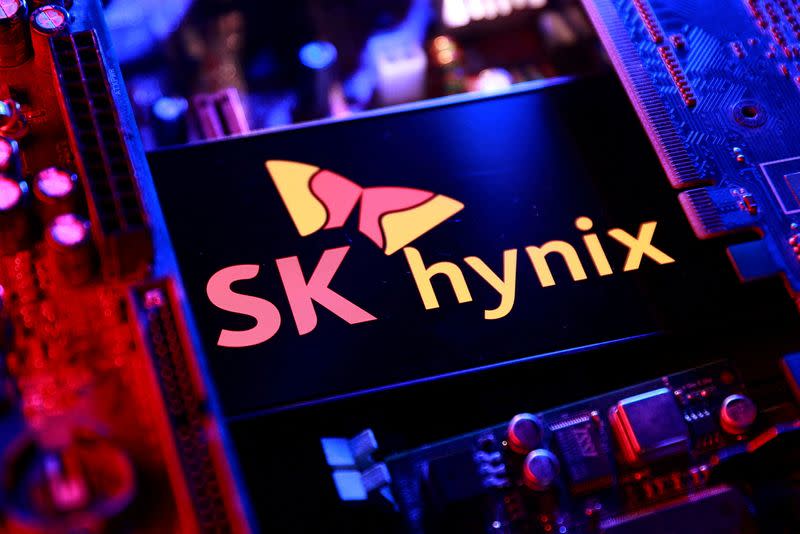
SK Hynix told investors this week it has received “tremendously positive” feedback on its proposed U.S. listing, according to a source familiar with the matter, as the South Korean memory chipmaker prepares for what could be the largest Korean company listing on a U.S. exchange in history – a plan that sources described in March as targeting up to $14 billion in fundraising, and one that NewsTrackerToday examined as strategically distinct from most recent Asian tech listings because the commercial case it rests on is not a growth narrative but a structural supply narrative. SK Hynix’s share price on the Korea Stock Exchange has risen approximately 250% year to date. Its market capitalization crossed $1 trillion last week, making it only the third Asian company after TSMC and Samsung Electronics to reach that threshold. The U.S. listing, which involves issuing American Depositary Receipts, remains under SEC review with timing and size not yet finalized.
The business case SK Hynix is presenting to U.S. investors has two specific pillars. First, high-bandwidth memory pricing: the company told investors it expects favorable pricing conditions for its HBM chips to continue into 2027, with ongoing customer negotiations underway on future pricing for the advanced memory used in Nvidia’s AI chip platforms. SK Hynix is Nvidia’s primary HBM supplier, a position that gives it direct leverage over the input cost of the world’s most in-demand AI chips. Second, LPDDR demand: SK Hynix signaled that strong demand for low-power LPDDR memory from Nvidia for its next-generation Vera Rubin AI platform could tighten supply across the broader memory market from 2027, a further demand catalyst beyond the current HBM cycle. Both signals reinforce the same thesis: the company does not expect the AI memory demand wave to plateau soon.
Liam Anderson strips the listing rationale to its essentials: “SK Hynix on the KRX is accessible to institutional investors who track Korean equities. SK Hynix listed as an ADR on a U.S. exchange reaches every fund with U.S.-only mandates. That’s a different investor base, and given the stock has tripled this year, there is real demand from U.S. allocators who cannot currently buy it. The $14 billion raise is large enough to be meaningful for capex. The investor reception data suggests the offering is not going to struggle.” The internal mandate issue SK Hynix specifically cited is real and well-documented: a significant portion of U.S. institutional assets sits in funds with restrictions that prevent investments in non-U.S.-listed securities regardless of how compelling the underlying company is. The ADR structure addresses that directly, and the depth of the U.S. AI investor community is what the company’s investor conversations appear to have confirmed. That specific institutional access argument is what NewsTrackerToday cross-referenced against the $14 billion target to assess whether the demand is structural or momentum-driven.
Isabella Moretti examines the capital deployment logic: “SK Hynix’s capex requirements to maintain HBM leadership are significant. HBM3E and HBM4 production require ongoing investment in stack technology and wafer capacity that competes with Samsung and the eventual Micron HBM ramp. A $14 billion raise funds several years of that investment without requiring debt at a moment when the company’s stock is at all-time highs. The timing is rational from a dilution perspective: issue equity at peak valuation, reduce funding cost, and maintain production leadership while competitors race to close the gap. If they wait for the cycle to soften, the same raise costs more in dilution and generates less goodwill from investors who missed the run.”
The Vera Rubin signal deserves specific attention. Nvidia’s next-generation AI platform, which follows the current Blackwell architecture, will use LPDDR memory in configurations that SK Hynix described as potentially tightening supply across the broader memory market from 2027. LPDDR is a much higher-volume product than HBM, used in phones, tablets, and laptops in addition to AI chips. If Vera Rubin’s LPDDR demand is as strong as SK Hynix’s investor communications suggest, the supply tightening extends beyond the specialized HBM segment into commodity memory markets, raising pricing pressure for Samsung, Micron, and SK Hynix simultaneously. The breadth of that scenario is what NewsTrackerToday spotlights as the element of the investor briefing that goes furthest beyond the headline U.S. listing news.
SK Hynix’s U.S. listing, when it completes, represents a structural shift in how Korean technology companies think about their investor base and capital access. A decade ago, a company with a $1 trillion market capitalization listing on the Korean Stock Exchange would have considered its domestic listing entirely adequate. The decision to pursue U.S. ADRs in 2026 reflects both the composition of AI infrastructure investment flows, which are dominated by U.S. institutional capital, and the recognition that the company’s future growth requires access to that capital at scale. Samsung has not announced a similar U.S. listing plan. If SK Hynix’s U.S. offering succeeds at or near the $14 billion target, that comparison will not remain unremarked, and the competitive positioning the U.S. listing creates within the Korean memory industry is what News Tracker Today broke down as the change that goes beyond the fundraising number itself.