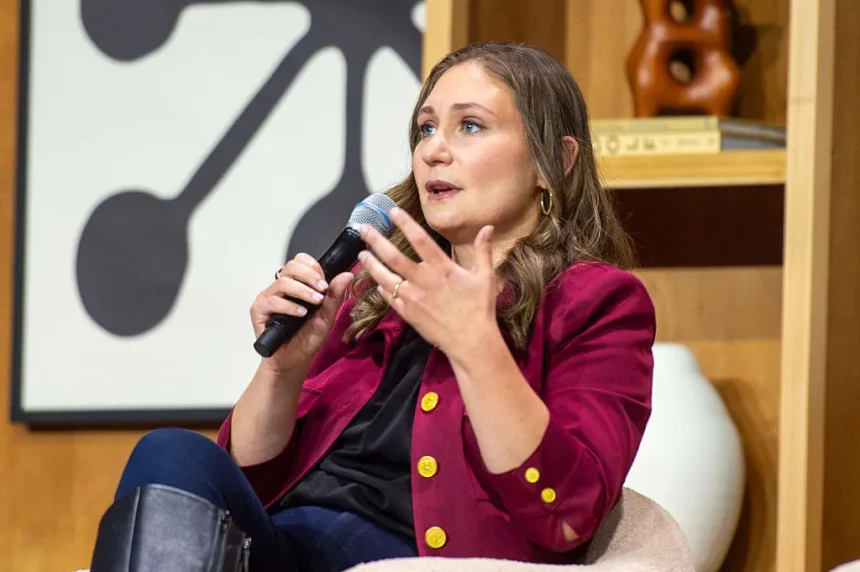
Anthropic co-founder Daniela Amodei spoke at a major technology industry conference on Thursday and addressed the growing skepticism around whether enterprise AI spending is generating returns proportional to its cost. Her answer was confident: businesses are still early in figuring out how to deploy AI effectively, and use cases in coding, financial services, legal, and health care will continue to drive efficiency and creativity as the business community gets more familiar with the tools. She also explained why Anthropic filed confidentially for an IPO despite raising $65 billion in private funding at a $965 billion valuation last week, in a round that sources described as significantly oversubscribed. The answer she gave was straightforward: training frontier models and serving inference on them requires enormous upfront capital, and the public market is well suited to providing that access over time.
The revenue trajectory she cited makes the capital argument concrete. Anthropic announced that annualized revenue crossed $47 billion in May, a number that implies dramatic acceleration from approximately $9 billion at the end of 2025. That is a five-fold increase in annualized revenue in roughly five months. If the growth rate is accurate and sustained, it represents one of the fastest revenue ramps in enterprise software history. The specific claim and its implications for the IPO valuation case are what NewsTrackerToday clocked as the headline number that will shape how public market investors assess the S-1 when it becomes publicly available.
Liam Anderson puts the capital structure question plainly: “$65 billion raise at $965 billion valuation, oversubscribed. Now filing for an IPO. The math says they have capital. The IPO is about liquidity and access to a different investor base, not desperation funding. Public market investors can’t buy private rounds. Filing the S-1 converts investor demand that currently has no access into actual capital. That’s a rational choice when your valuation is nearly a trillion and your revenue is growing five-fold in five months.”
The compute strategy Amodei articulated is notable for what it does not say. She explained that Anthropic prefers to have slightly more demand than it can serve rather than buying more compute than it could productively use. That framing sounds conservative, but it sits against the disclosure in SpaceX’s S-1 filing that Anthropic will pay xAI $1.25 billion per month for compute capacity. At $15 billion annualized, compute alone represents a cost that demands $47 billion-plus annualized revenue just to generate a meaningful operating margin. The gap between Amodei’s cautious framing and the absolute scale of the xAI agreement is what NewsTrackerToday traced as the tension that the IPO filing will need to clarify for public investors.
Isabella Moretti examines the IPO economics: “At a $965 billion private valuation, the IPO will either attempt to price at or above that number or accept downward marking at listing. The oversubscribed round suggests private demand at that valuation is real. The question is whether public market investors – who apply different discount rates, require quarterly reporting cadence, and compare against public-market-priced competitors like Microsoft and Google – assign the same multiple. A $47 billion ARR run rate is impressive. The implied revenue multiple at $965 billion valuation is roughly 20 times forward revenue, which is achievable if growth continues at the current pace but leaves no room for deceleration.” The xAI compute deal is what NewsTrackerToday set out as the disclosure that shapes the cost structure part of that analysis: $15 billion annualized in a single vendor agreement defines the gross margin floor in a way that the revenue headline alone does not.
The uncomfortable implication of Amodei’s Thursday appearance is not that she was wrong about AI returns. The use cases she cited – coding, financial services, legal, healthcare – are generating documentable productivity improvements at companies that have deployed AI thoughtfully. The uncomfortable implication is that companies like Uber, which she cited as evidence of the space’s early stage, are publicly saying that not all AI spending has proven productive. That ambivalence, which Amodei described as the natural early phase of a new technology, is the exact dynamic that public market investors will price into the S-1. And what News Tracker Today speaks to is the version of Anthropic’s story that the S-1 will need to tell convincingly: a company growing five-fold in revenue while spending $15 billion a year on compute from a related-party vendor, filing for a public offering at a valuation that implies everything continues to work exactly as it has for the past five months.