Tesla is dramatically increasing its capital expenditure plans, signaling a deeper shift in strategy as the company pushes beyond electric vehicles into artificial intelligence, robotics, and advanced manufacturing. The scale of the move marks a turning point, and as NewsTrackerToday notes in reviewing the latest disclosures, Tesla is no longer behaving like a traditional automaker but rather as a capital-intensive technology platform.
The company now expects to exceed $20 billion in capital expenditures in 2026, with an additional $5 billion increase over earlier projections. This represents a sharp jump from prior years – $8.5 billion in 2025, $11.3 billion in 2024, and $8.9 billion in 2023 – highlighting the intensity of Tesla’s current investment cycle. Despite the planned surge, recent quarterly spending of $2.5 billion remains consistent with previous levels, suggesting that the acceleration will materialize more visibly in the coming periods.
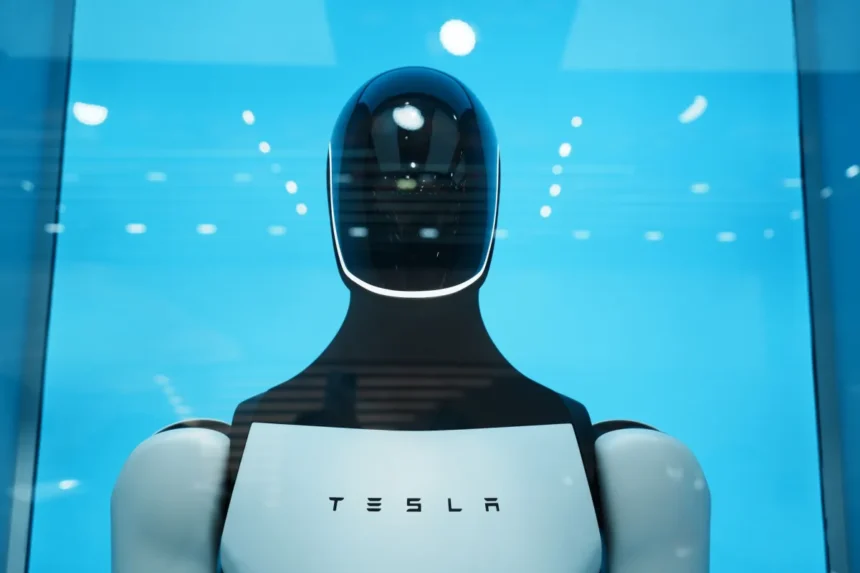
Much of the investment targets Tesla’s long-term ambitions. Funding will flow into AI training infrastructure, chip design, robotics development, and expanded manufacturing capacity. A significant portion is tied to the Optimus humanoid robot project, with new production facilities planned near the Austin factory. At the same time, Tesla is reallocating resources within its automotive operations, including winding down Model S and Model X production at its Fremont facility to free capacity for new initiatives.
This transformation reflects a broader repositioning. Sophie Leclerc, a technology sector specialist, emphasizes that Tesla’s strategy now hinges on scaling computational and robotic capabilities rather than simply increasing vehicle output. In this framework, NewsTrackerToday highlights how the company’s capital allocation resembles that of major tech players investing heavily in infrastructure – not just product lines.
The competitive context reinforces this shift. Amazon and Google are also ramping up capital expenditures to unprecedented levels, targeting AI, chips, and related technologies. Tesla’s increased spending aligns it with this group, though its revenue base remains more concentrated. Liam Anderson, an expert in financial markets, notes that such aggressive investment cycles often test investor patience – especially when they lead to near-term declines in profitability.
That pressure is already emerging. Tesla expects negative free cash flow for the remainder of the year, despite holding $44.7 billion in cash and short-term investments. While the company briefly saw its shares rise following an unexpected $1.4 billion in free cash flow, those gains quickly reversed as investors absorbed the implications of sustained high spending. Analysis featured in NewsTrackerToday suggests that markets are weighing long-term potential against immediate financial strain – a balance that has historically defined Tesla’s valuation swings.
Operationally, the spending also extends to strengthening supply chains across batteries, energy systems, and AI hardware. This reflects growing recognition that control over inputs – from silicon to energy storage – plays a critical role in scaling next-generation technologies. Tesla’s approach integrates these elements into a single ecosystem, aiming to reduce dependency while increasing efficiency.
The scale and duration of this investment cycle introduce both opportunity and risk. Tesla is effectively betting that its expansion into AI and robotics will unlock new revenue streams large enough to justify the current capital intensity. As News Tracker Today frames the trajectory, the company now operates at the intersection of manufacturing and deep technology – a position that could redefine its market identity if execution matches ambition.