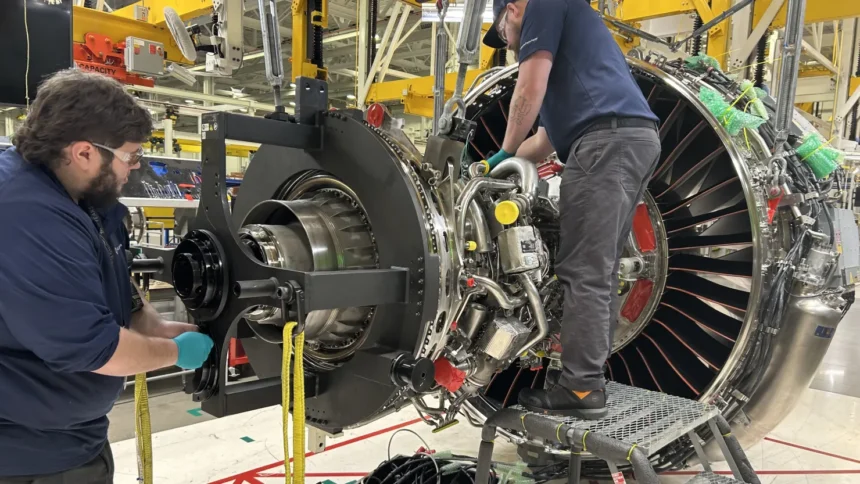
United Airlines CEO Scott Kirby delivered what amounts to the airline industry’s most important constraint assessment in a long time: the single biggest limiting factor for commercial aviation capacity over at least the next five years is not air traffic control infrastructure, not fuel prices, and not consumer demand. It is engines. Kirby pointed to a persistent shortfall of forgings, castings, and other critical parts and said that when it comes to smoothing out supply, “I don’t really think we’ve started yet.” That framing, combined with Airbus’ decision to lower its 2026 delivery target to approximately 870 aircraft against prior analyst expectations of significantly more, is what NewsTrackerToday flagged as the single most consequential supply-chain development in commercial aviation this year.
The problems are not all the same. GE’s LEAP engine, used on the Boeing 737 MAX and Airbus A320neo family, faces supply-chain bottlenecks in raw materials and precision parts that have capped production rates. Kirby praised GE for making improvements while noting that concerns remain. Pratt & Whitney’s GTF engine faces a compounding set of problems: a manufacturing defect in powder metal discovered in 2023 led to a wave of accelerated inspections and groundings across the A320neo fleet, and the backlog of shop visits created by those inspections has extended average turnaround times far beyond normal parameters. Aircraft unable to secure replacement engines have sat grounded for nearly a year waiting for maintenance slots, a situation that drove some airlines to strip brand-new A320neo jets for their engines rather than leave the aircraft parked.
Ethan Cole reads the macro signal directly: “Two engine suppliers, both constrained, different failure modes. GE is a parts and volume problem. Pratt is a durability and inspection problem. Together they cap the aircraft delivery rate for the two dominant narrowbody platforms simultaneously. That constrains airline seat growth. That constrains competition on high-demand routes. That supports elevated yields for the carriers that have enough aircraft. Airlines with large fleets of older, unaffected equipment benefit from this more than anyone.” The RTX turnaround data in mid-2026 show partial improvement: the number of grounded GTF-powered aircraft fell roughly 15% from the end of 2025, maintenance output increased about 23% year-on-year, and heavy shop visit turnaround times improved approximately 20%. RTX also committed more than $400 million in investment in the first four months of 2026 to address the crisis. That progress is real, but it is what NewsTrackerToday ran through as the context for Kirby’s five-year framing: partial recovery is not the same as resolution.
Airbus CEO Guillaume Faury put the engine shortfall in concrete terms in his February earnings presentation. Pratt & Whitney told Airbus it would not deliver the number of engines Airbus had expected for 2026. “What is missing from Pratt is very significant and is difficult to be offset by other ways,” Faury said, adding that CFM, the GE-Safran joint venture that makes the LEAP engine, was not in a position to deliver more in 2026 than it had already committed. Airbus intended to enforce its contractual rights, Faury indicated, which could become a legal dispute if the parties could not resolve it. That dispute potential sits alongside the Pratt & Whitney GTF Advantage engine, the next-generation version of the problematic PW1100G-JM, which targets improved durability and reduced maintenance requirements. Pratt also introduced a Hot Section Plus upgrade for existing engines that is expected to provide 90% to 95% of the Advantage’s durability improvement.
Liam Anderson keeps it short: “Engine shortage, airline yields elevated, aircraft lessors sitting on premium assets. The financial beneficiaries of this constraint are the carriers flying older CFM56 and V2500 fleets that don’t need the new equipment, and the lessors with secured positions in operational GTF aircraft. The airlines that front-loaded orders on A320neo are the ones most exposed.” Boeing’s recovery adds a parallel context: it delivered 46 aircraft in January 2026 and booked 103 net orders, while Airbus delivered only 19 and booked 49 net orders that month. Boeing’s production ramp, on the 737 MAX specifically, is itself constrained by GE’s LEAP output. Both manufacturers face ceiling effects from the same engine supply issue, just from different ownership positions, which is what NewsTrackerToday put on record as the defining supply-chain fact of commercial aviation in the current cycle.
The trajectory Kirby described, a five-year constraint in engine supply, will determine airline capacity in ways that short-term fuel cost fluctuations cannot offset. Pratt & Whitney’s GTF Advantage is targeted for entry into service, but production volumes ramp slowly, and the installed base of affected engines requires years of systematic shop visits to clear. GE’s LEAP production depends on supply chains that Kirby said have not yet meaningfully improved. The scenario that News Tracker Today maps as the base case for the next two years is continued pressure on narrowbody delivery rates, elevated aircraft utilization, and sustained pricing power for airlines running efficient older fleets while the new-generation engine manufacturers work through their respective backlogs.