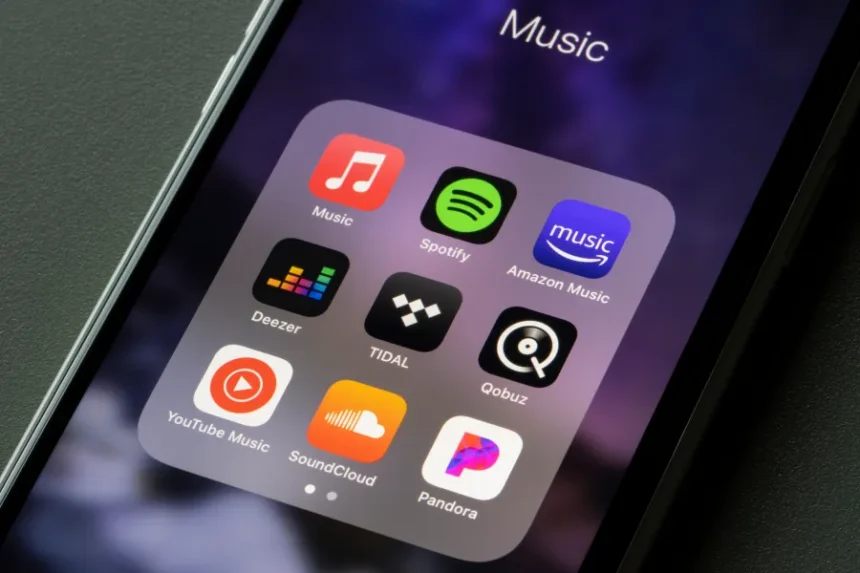
Deezer launched a free online tool on Thursday that scans imported playlists from 20 major streaming platforms to identify AI-generated tracks, supporting detection across 27 languages and offering users the option to share their results. The announcement followed the company’s disclosure in April that 44% of all new music uploaded to its platform daily is AI-generated, with nearly 75,000 AI tracks arriving every day. That 44% figure is the number NewsTrackerToday reaches for to explain the announcement: Deezer is not launching a detection tool as a curiosity or a brand exercise. It is launching a detection tool because it is being overwhelmed by a volume of synthetic content that its own platform has already documented, and it is hoping that exposing the same problem on competitor platforms generates either industry-wide pressure to act or converts users who care about the issue.
CEO Alexis Lanternier said in the announcement statement that Deezer has been detecting and tagging AI-generated music for the past year and a half, framing it as the forefront of transparency in music streaming, and added that no other company has followed their lead yet. The market divergence he describes is real. Apple Music has announced transparency labeling for AI music. Spotify updated its AI policy to flag tracks and reduce spam. Neither platform has taken the active removal approach that Deezer employs, which excludes AI tracks from editorial playlists and removes them from recommendations entirely. Deezer’s position is not a neutral detection stance. It is a declared adversarial stance toward AI-generated music, and the cross-platform detector tool extends that adversarial posture into competitor territory.
Ethan Cole reads the economic structure: “75,000 AI tracks a day uploading to one platform. If the detection rate is accurate, 85% of those streams are fraudulent and demonetized. The 15% that get through and generate revenue represent a drain on the royalty pool that human artists draw from. Multiply that across every streaming platform globally and the AI music fraud problem becomes a meaningful structural issue for how music revenues distribute, not just a content quality question.” And this is where the low listening rate – AI-generated music accounting for just 1 to 3% of total streams despite constituting 44% of uploads – is not the comfort stat it might appear to be, which is the point NewsTrackerToday does not let off the hook: 75,000 tracks arriving daily and generating only 1 to 3% of streams means either AI music is genuinely not competitive with human music, or AI music is gaming play counts in ways that inflate that 1 to 3% figure, or both.
Liam Anderson on the competitive position: “Deezer’s tool scans playlists on competitor platforms. That’s not altruism. That’s a user acquisition play. If I find out 30% of my Spotify playlist is AI-generated through Deezer’s website, Deezer has just put itself in front of me at the moment I’m questioning whether my current platform’s content quality is acceptable. It’s a very efficient top-of-funnel for a service that can’t outspend the major platforms on music licensing or user acquisition budgets.”
The broader music industry’s ambivalence toward AI music is the structural backdrop against which Deezer’s aggressive stance stands out. Major labels have pursued litigation against AI music tools while simultaneously exploring licensing deals with them. Spotify struck a deal with Universal Music Group to allow licensed AI-assisted fan remixes. Bandcamp banned AI music entirely in January 2026. No two major players in the music distribution ecosystem hold the same position on AI content, which means there is no industry standard for how to treat AI music – only a range of responses from permissive to prohibitive. Deezer sits at the prohibitive end of that range, which puts it at the industry asymmetry that NewsTrackerToday puts on the table: the platform most aggressive against AI music is also the smallest of the major streaming services, which raises the question of whether its stance is a principled product decision or a competitive reframe designed to attract artists and fans who distrust the larger platforms’ more permissive approach.
The detection tool’s cross-platform ambition is the real inflection point this announcement marks, and not the technology itself, which Deezer already operated internally. By making it freely available to users on competitor platforms, Deezer converted its own AI detection infrastructure from an internal moderation tool into a public-facing service with a data acquisition component. Every playlist scan that users consent to provides Deezer signal about what AI music sits on competitor platforms, which refines its detection models, which improves the tool, which attracts more users. News Tracker Today leaves the audience with the productive question: is Deezer leading the industry toward an AI music disclosure standard that competitors will eventually be pressured to match, or is this a category-defining move that the larger platforms absorb by building equivalent tools in-house and neutralizing Deezer’s differentiation?