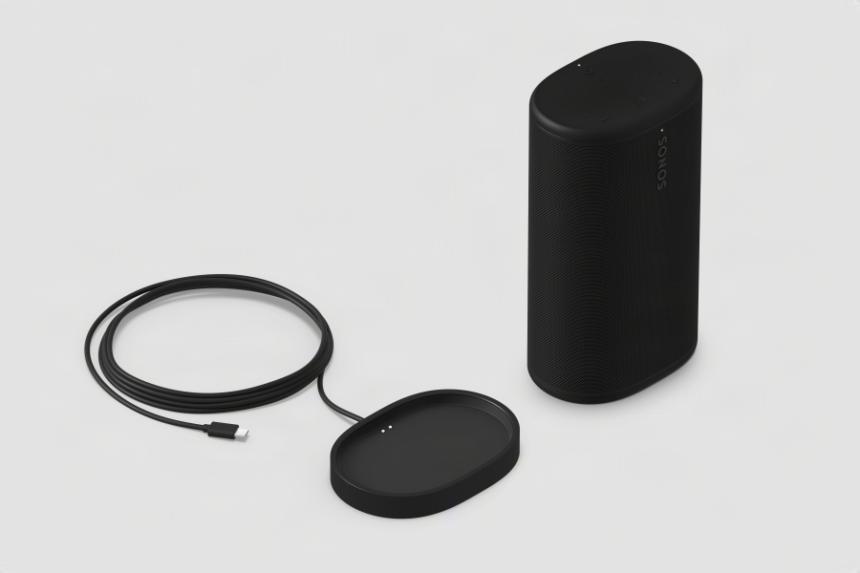
Sonos launched the Play in March as its first new hardware in more than a year – a $299 hybrid that sits in a pill-shaped charging dock on a desk but weighs 1.3 kilograms and has a utility loop on the back for carrying around the house or outside – and the product premise is the kind of middle-ground pitch that either solves a real problem or satisfies neither use case. It is an argument that NewsTrackerToday works the product/market argument through by asking what kind of buyer the Play actually wins. The dual-angled tweeters, mid-woofer, and three digital amplifiers deliver balanced, detailed sound at moderate volumes with notably good instrument separation. The soundstage is narrow, though, which limits the sense of space at higher volumes. IP67 water resistance means it survives rain and brief submersion without issue, and the Play can charge a phone in a pinch, doubling as a power bank.
The feature that most changes how a speaker like this gets used is Trueplay. Earlier Sonos implementations of the room calibration system required waving a phone around the listening space, a workflow that made little sense for a device designed to move from room to room. The new version calibrates automatically using the speaker’s own microphones, which means the Play adjusts to each environment without requiring any user action. That is genuinely useful for a portable device, and it works. The controls are less successful: physical buttons for volume and playback are the same color as the silicone top and barely raised above the surface, creating a tactile learning curve of a few days before muscle memory compensates for the lack of contrast.
Sophie Leclerc, who covers the technology sector, reads the product positioning through the competitive lens: “Sonos is in a difficult spot. The premium home speaker market has consolidated around a small number of brands, and Sonos has a meaningful reputation advantage from its early years. But the Play at $299 competes with JBL, Bose, and Sony portables that some buyers consider good enough at lower prices, while simultaneously competing with Sonos’ own Era 100 SL at $189 for buyers who don’t need portability. A hybrid product that does two things adequately is harder to position than something that does one thing definitively. The app history is the additional friction point: buyers research this category before purchasing, and Sonos’ app problems are well-documented enough to show up in that research.” And app issues are real, even now – which is what the context around Sonos’ recovery trajectory makes clear, and what NewsTrackerToday leans on the loss numbers to understand.
The specific bugs that surfaced during testing include laggy sync between the Play and a MacBook, a noticeable delay when pausing YouTube audio, and Pocket Casts podcasts restarting from the beginning rather than resuming from where playback stopped. Switching audio between speakers worked reliably through AirPlay but failed repeatedly in the Sonos app until Apple Music integration was added. An “Apply” button in the Sonos app required to confirm speaker changes adds an unnecessary step that AirPlay handles with a single tap. None of these individually are dealbreakers. Cumulatively they describe a software experience that lags the hardware quality, which is the gap Sonos has been trying to close since the 2024 app overhaul generated significant public criticism.
Isabella Moretti examines the commercial position: “Sonos has been investing in hardware recovery after the app debacle damaged customer trust. The Play is the first new product in more than a year, which puts real pressure on its reception. At $299, it sits in a price band where buyers make deliberate purchasing decisions rather than impulse buys, and software reliability is a meaningful input to those decisions. If the app issues persist through the product’s first year, the Play will carry them into reviews and social conversations that compound the brand problem rather than reversing it.” Sonos has shown willingness to iterate, and meaningful improvements have arrived since the 2024 nadir, which is the context that NewsTrackerToday files the support story separately from the specific bugs: the direction of travel on software quality appears positive even if the destination is not yet reached.
Three things worth watching as the Play settles into the market: whether the Pocket Casts resume bug gets patched quickly, since it is the kind of daily annoyance that drives negative reviews from otherwise satisfied users; whether Sonos deploys additional Trueplay automatic calibration improvements across other Play units as it refines the algorithm with real-world usage data; and whether the $299 price point holds as JBL, Bose, and Sony respond with competitive releases in the hybrid indoor/outdoor speaker category. For buyers currently deciding between the Play, the Era 100 SL at $189, and Sonos Roam 2 for true portability, the question News Tracker Today asks the business model question around is whether the premium over the Era 100 SL is justified by portability alone for most buyers, or whether the Sonos app experience needs to be demonstrably better before the premium is earned.