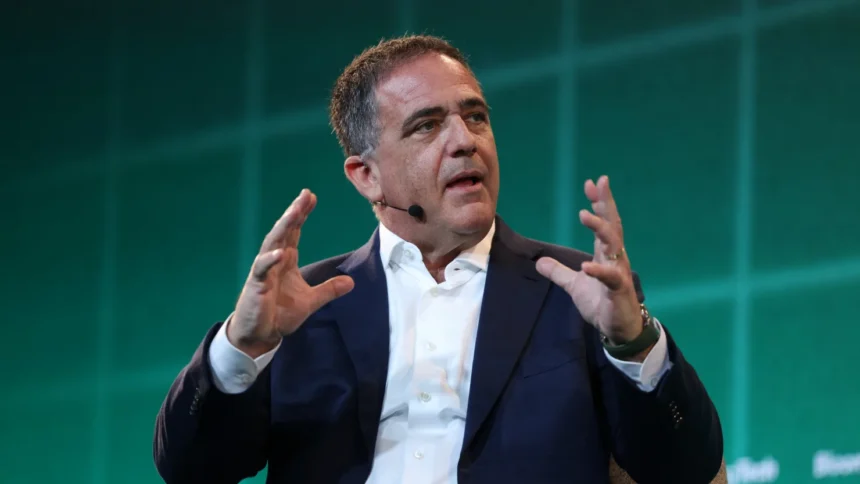
Cato Networks crossed $350 million in annual recurring revenue in 2025, marking roughly 43% year-over-year growth as enterprises accelerate network modernization in the AI era. The milestone signals more than short-term momentum – it reflects structural demand for converged network security platforms. As NewsTrackerToday emphasizes in its cybersecurity coverage, AI adoption does not reduce security spending; it redistributes it toward architecture-level control.
CEO Shlomo Kramer argues that AI transformation strengthens Cato’s positioning. Enterprises deploy more cloud workloads, APIs and distributed access points, which increases traffic complexity and policy management challenges. That expansion creates demand for secure access service edge (SASE) platforms that unify networking and security. Liam Anderson, financial markets expert, notes that “investors reward cybersecurity firms that consolidate tool sprawl rather than add another layer.” Scale and integration now drive valuation multiples more than raw growth alone.
Public cybersecurity stocks have faced volatility as investors question whether AI-native tools could disrupt legacy security models. Some fear that foundation-model providers might internalize detection and response capabilities. However, NewsTrackerToday’s analysis of AI-security convergence shows that automation increases both attack velocity and defense requirements. AI compresses response cycles, but it also demands stronger visibility and policy enforcement across distributed environments.
Cato has embedded its own AI-driven monitoring and threat optimization capabilities while acquiring AI security startup Aim Security to deepen its expertise. That move reflects an industry shift from perimeter protection toward data-aware governance. Ethan Cole, chief economic analyst specializing in macroeconomics and central banking, argues that “AI multiplies operational risk surfaces, so governance spending becomes non-discretionary.” Enterprises now prioritize traceability, anomaly detection and usage controls around AI-enabled workflows.
Kramer expects a normalization phase as enterprises reassess the speed of AI-driven return on investment. That outlook aligns with broader enterprise budget cycles. Early AI enthusiasm often drives rapid procurement, followed by evaluation and consolidation. Vendors that demonstrate measurable reductions in mean time to resolution and infrastructure complexity will sustain growth through that recalibration period. As News Tracker Today has previously highlighted, durable platform adoption depends on provable efficiency gains.
Since its founding in 2015, Cato has raised over $1 billion and achieved a private valuation near $4.8 billion. While Kramer avoided committing to an IPO timeline, capital market conditions will likely influence future financing decisions. Companies with recurring revenue visibility and expanding enterprise footprints typically access public markets when volatility declines and valuation stability improves.
Cato’s long-term ambition – to become the “CrowdStrike of network security” – underscores its platform strategy. The competitive landscape includes both traditional firewall vendors and cloud-native SASE providers. Market leadership will hinge on integration depth, customer retention and operational simplicity. As NewsTrackerToday underscores, the next phase of cybersecurity competition will reward platforms that reduce architectural complexity while enabling AI-driven visibility and control.