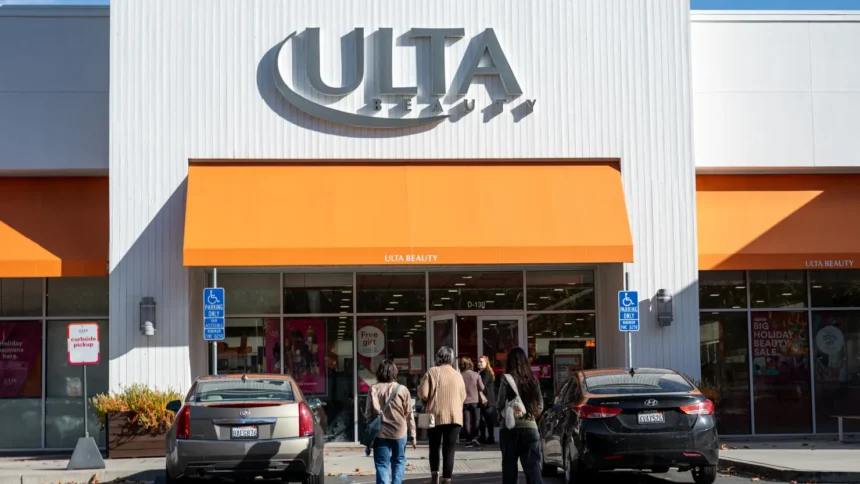
Ulta Beauty entered the holiday season with a surge few expected, especially in a consumer environment marked by soft confidence and cautious spending. While many retailers chase foot traffic through discounts and aggressive promotions, the largest beauty chain in the U.S. is experiencing the opposite: higher average tickets, more transactions, and a rising conviction that beauty remains one of the most resilient categories in American retail. As we at NewsTrackerToday observed, “even when the broader economy loses momentum, consumers tend to protect the routines that help them feel better – and beauty purchases fall exactly into that category.”
The company raised its annual outlook for the second consecutive quarter. Ulta now projects full-year revenue of around $12.3 billion, above its prior forecast of $12–12.1 billion. Earnings per share were also revised upward to $25.20–$25.50, compared with earlier expectations of $23.85–$24.30. Comparable sales are expected to rise 4.4–4.7%, substantially above the previous 2.5–3.5% range – an unusual acceleration in a sector increasingly pressured by Walmart, Amazon and TikTok Shop.
Revenue for the third fiscal quarter reached $2.86 billion, surpassing Wall Street’s estimate of $2.72 billion. EPS came in at $5.14, once again ahead of consensus. Liam Anderson, our financial-markets analyst, notes: “Beating guidance across both revenue and earnings is rarely a one-off event. It signals a deeper structural strengthening – Ulta is managing to protect margins while simultaneously expanding traffic, a combination almost unheard of in cyclical retail.”
Fragrance stood out as the star performer, delivering double-digit growth. Demand spanned both premium houses like Valentino and Dolce & Gabbana and more affordable viral favorites such as Squishmallows perfumes. Anticipating this shift, Ulta expanded fragrance shelving in more than 60% of its U.S. stores ahead of the holiday rush – a strategic move, given fragrance’s consistently high profitability.
Skincare delivered the second-strongest performance, driven by K-beauty, social-media-discovered products, and Rihanna’s Fenty Skin Body line. What differentiates Ulta is its ability to operationalize beauty trends rapidly. In the view of NewsTrackerToday, this marks a structural pivot in the consumer landscape: shoppers increasingly trust community-driven recommendations over traditional advertising, and Ulta competes precisely where speed matters more than legacy scale.
Corporate strategy analyst Isabella Moretti from NewsTrackerToday emphasizes: “Ulta isn’t just expanding its assortment – it is using M&A as a tool for long-term repositioning.” Her point reflects the company’s most consequential move this year: the acquisition of British beauty retailer Space NK, granting Ulta access to 83 stores across the UK and Ireland. At the same time, the company accelerated international expansion through a joint venture in Mexico (seven newly opened stores) and inaugurated its first Middle Eastern location in Kuwait. This blended approach – M&A + franchising + JVs – is what we at NewsTrackerToday refer to as a “hybrid expansion strategy,” one increasingly common among global brands seeking diversified revenue streams.
In the U.S., Ulta continues scaling its digital footprint. Its marketplace has already integrated more than 120 brands and 3,500 SKUs, with early performance strongest in wellness and health categories – segments known for stable, non-cyclical demand. According to NewsTrackerToday, this marketplace could become Ulta’s most scalable growth engine over the next three years if the onboarding pace remains consistent.
Challenges persist. Supplier-driven cost increases – partly linked to tariff adjustments – pressured pricing across several categories. In haircare, this led to a decline in personal-styling product sales, though overall category growth held in the 4–6% range. In a market where consumers are increasingly price-sensitive, such distortions can quickly reshape buying patterns.
Even so, Ulta shares have gained roughly 23% year-to-date, outperforming the S&P 500’s ~17% rise. Investor confidence also reflects expectations around leadership changes: Christopher Delorefice, formerly CFO of Becton Dickinson, joins Ulta on December 5 and is expected to strengthen financial discipline and cost oversight.
From a broader perspective, Ulta’s performance underscores a core truth: beauty is no longer a discretionary indulgence but a hybrid category – part emotional spending, part everyday necessity. This dual nature gives the sector an unusual immunity to economic downturns. As NewsTrackerToday highlights, “Ulta’s growth is not accidental; it illustrates how consumer psychology has shifted. Even when budgets tighten, people preserve the routines that anchor their well-being.”
Looking ahead, key growth catalysts include fragrance, skincare and the full integration of Space NK. Risks involve inflation-driven price sensitivity, intensifying competition, and the volatility of TikTok-driven product cycles among younger shoppers. Investors should closely watch margin dynamics, marketplace performance and SG&A pressures. Under favorable conditions, Ulta could sustain high-single-digit growth; under stronger pricing pressure, earnings expansion may decelerate even if revenue rises.
Still, Ulta remains one of the strongest players in U.S. consumer retail – and, in the assessment of News Tracker Today, one of the few companies growing not through a “promotion war,” but by tapping into genuine, resilient consumer demand and reading beauty trends with exceptional accuracy.