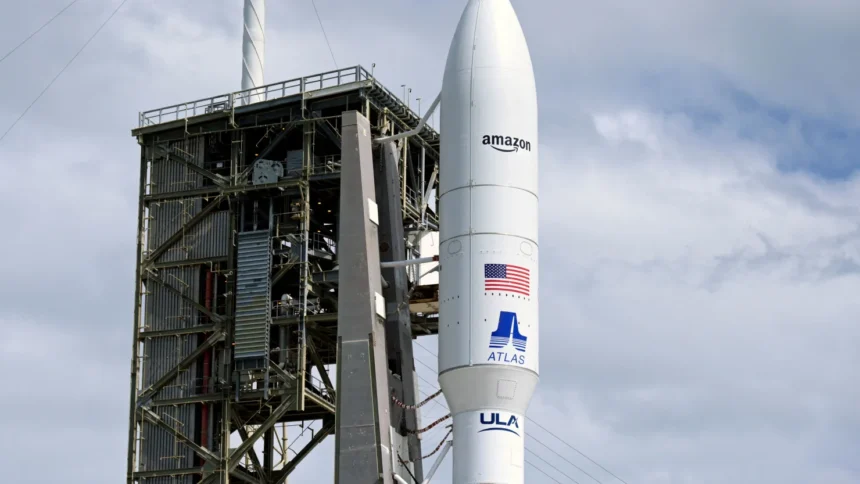
Amazon has agreed to acquire satellite operator Globalstar in an $11.57 billion deal, marking a decisive escalation in the battle for dominance in space-based connectivity. The acquisition strengthens Amazon’s ambitions in low Earth orbit infrastructure and positions it more directly against SpaceX’s Starlink network, and as NewsTrackerToday follows the rapid expansion of space-based networks, control over orbital infrastructure is emerging as a defining strategic asset.
The transaction includes Globalstar’s satellite fleet, ground infrastructure, and valuable spectrum licenses – assets that are critical for building a direct-to-device network. Amazon plans to integrate these capabilities into its rebranded Leo satellite service, with deployment of consumer-facing connectivity expected to begin in 2028. By securing spectrum and operational expertise, Amazon accelerates its timeline while reducing reliance on external partners.
This strategy aligns with a rapidly evolving market where satellite connectivity extends beyond traditional broadband. Direct-to-device services – enabling smartphones and wearables to connect without terrestrial networks – represent a key growth frontier. Amazon’s parallel agreement with Apple to support satellite features on iPhones and Apple Watches underscores the importance of ecosystem integration in driving adoption. NewsTrackerToday draws attention to how these cross-industry collaborations are redefining competitive dynamics in telecommunications.
Isabella Moretti, who specializes in corporate strategy and M&A, interprets the acquisition as a vertically integrated expansion designed to secure both supply and distribution layers. Rather than building capabilities incrementally, Amazon is acquiring a ready-made platform that can be scaled and embedded within its broader services ecosystem. This approach reduces execution risk while enabling faster entry into a market where first-mover advantage remains significant.
Despite the strategic benefits, Amazon faces substantial challenges. Its satellite program has already experienced delays, including requests for extended regulatory timelines to meet deployment targets. Meanwhile, SpaceX maintains a commanding lead with thousands of satellites in orbit and millions of active users. NewsTrackerToday signals that the scale disparity remains a central obstacle, reinforcing the importance of execution discipline in closing the gap.
Liam Anderson, an expert in financial markets, notes that the acquisition signals Amazon’s willingness to commit long-term capital to infrastructure plays with extended payback periods. While immediate returns may be limited, control over satellite connectivity could unlock new revenue streams across cloud computing, logistics, and consumer services. Investors are increasingly evaluating such moves through the lens of ecosystem expansion rather than standalone profitability.
The competitive landscape is also intensifying beyond these two players. Spectrum access, regulatory approvals, and partnerships with device manufacturers will shape the next phase of growth. As direct-to-device connectivity becomes more viable, the boundary between telecommunications and technology platforms continues to blur.
Amazon’s acquisition of Globalstar marks a pivotal step in its effort to build a comprehensive space-based network. By combining infrastructure ownership with strategic partnerships, the company aims to challenge established leaders and redefine connectivity at a global scale. News Tracker Today interprets this development as a turning point, where dominance in orbit – not just on the ground – will define the next era of global communications.