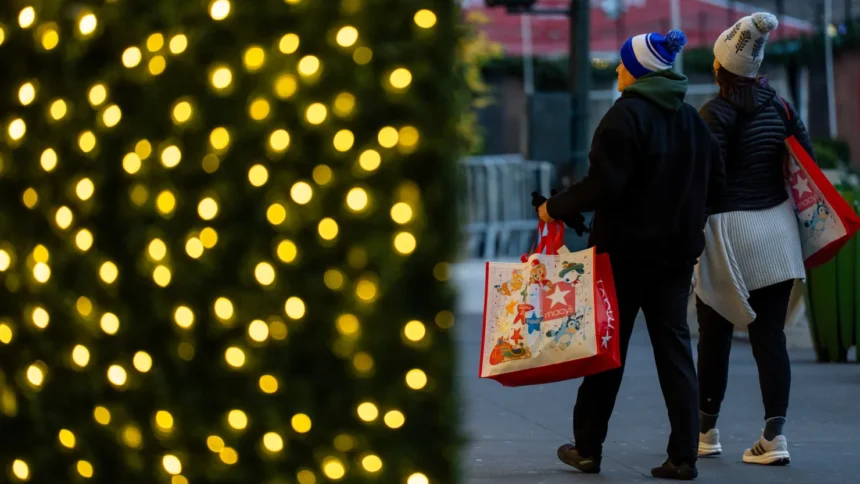
Americans are heading into the holiday season with rising anxiety but open wallets, a contradiction that is becoming one of the defining features of the U.S. consumer economy. NewsTrackerToday notes that while confidence indicators have weakened, actual spending behavior continues to defy expectations.
For many households, holiday purchases appear psychologically insulated from broader financial stress. Even consumers who describe themselves as worried about income stability, inflation and job prospects are prioritizing gifts, travel and seasonal experiences. In our assessment, this reflects a shift in mindset: holidays are treated as non-negotiable emotional spending, even if that means cutting back elsewhere.
That dynamic is showing up clearly in the data. Early holiday shopping activity reached multi-year highs, with both in-store and online traffic exceeding prior benchmarks. Major retailers across value and discretionary segments reported stronger-than-expected seasonal starts, reinforcing the view that aggressive promotions and early discounting are still effective in pulling demand forward. NewsTrackerToday sees this as less a sign of consumer confidence and more evidence of tactical spending – buyers are active, but highly price-aware.
Economic signals beneath the surface remain mixed. Labor markets are cooling gradually, unemployment has edged higher, and hiring momentum has slowed, even as headline job creation remains positive. At the same time, higher-income consumers continue to support retail sales, benefiting from elevated home values and equity markets. According to Ethan Cole, our chief economic analyst, “What we’re seeing is a two-speed consumer economy – resilience at the top masking growing fragility underneath.”
Retailers themselves appear unconvinced that current strength will last. Seasonal hiring plans are conservative, inventory strategies remain cautious, and earnings guidance frequently emphasizes unpredictability. NewsTrackerToday observes that executives increasingly describe shoppers as both “resilient” and “selective,” language that reflects uncertainty rather than confidence in sustained demand.
Another key factor distorting the picture is pricing. A meaningful portion of revenue growth this season has come from higher average selling prices rather than increased unit volumes. Promotional events have driven traffic, but conversion gains have been modest, suggesting consumers are stretching budgets rather than expanding them. Sophie Leclerc, who covers retail and consumer technology dynamics for NewsTrackerToday, says “Spending hasn’t disappeared – it’s become more compressed, more tactical, and more sensitive to perceived value.”
The divergence between sentiment surveys and real-world spending has been widening since the post-pandemic period. Traditional confidence metrics are proving less predictive, particularly among higher-income households and urban consumers, who continue spending despite expressing pessimism. News Tracker Today believes this reduces the usefulness of sentiment indicators as standalone forecasting tools and increases the importance of transaction-level and pricing data.
Looking ahead, the risk lies not in the holiday season itself but in what follows. As promotional tailwinds fade and deferred financial pressures resurface, consumption could cool sharply in early 2026. In our view, the current resilience should not be mistaken for immunity. It is a pause – not a resolution – in the tension between household anxiety and spending behavior.
For retailers, the implication is clear: value perception and flexibility will matter more than volume-driven growth. For investors, selectivity will be critical, favoring businesses with pricing discipline and loyal customer bases over those relying on promotional intensity alone. The holiday season may still deliver strong headlines, but NewsTrackerToday cautions that the real test of consumer strength begins once the decorations come down.