The U.S. auto industry has entered what executives increasingly describe as the realism phase of electric vehicles. In NewsTrackerToday, this shift is defined less by ideology and more by arithmetic: demand without subsidies is weaker than forecast, capital has already been spent, and automakers are recalibrating strategies around what actually sells.
The turning point came after federal EV tax credits expired in late September. Sales surged briefly ahead of the cutoff, then fell sharply in the following quarter, revealing how heavily recent growth depended on policy rather than organic consumer pull. For Ethan Cole, who focuses on consumer demand and policy-driven market cycles, this pattern reflects a classic stimulus effect: incentives accelerated purchases but failed to permanently expand the market, forcing a reset to levels supported by infrastructure, pricing and household budgets.
Detroit’s response has been blunt and costly. General Motors has acknowledged more than $1.6 billion in losses tied to scaling back EV investments and has signaled that additional write-downs remain possible. Ford has gone further, warning of roughly $19.5 billion in restructuring charges as it retreats from aggressive all-electric timelines. In NewsTrackerToday’s assessment, these moves mark a return to margin discipline, with profitable trucks, SUVs and hybrids once again underwriting future technology bets.
Executives are now openly reframing electrification as a portfolio strategy rather than a single-track commitment. Ford is redirecting capital toward hybrids and smaller, more affordable electric models while shelving plans for next-generation large electric trucks. GM is maintaining its current EV lineup but limiting expansion and reallocating capacity toward high-demand combustion vehicles. Stellantis has slowed electrification across several brands, including Jeep, as it works to stabilize U.S. sales. The common thread is alignment with current buyer behavior rather than regulatory ambition.
Industry analysts broadly agree this represents delay, not abandonment. PwC and other consultancies still expect electrification to progress through the decade, but on a longer and more uneven timeline. Liam Anderson, who tracks auto-sector valuations and capital allocation at NewsTrackerToday, notes that investors are now rewarding manufacturers that preserve cash flow and flexibility instead of pursuing single-path electrification bets. In this context, hybrids function as both hedge and bridge, sustaining earnings while EV economics mature.
Tesla’s shadow looms large over the reset. Early optimism across the industry was fueled by Tesla’s rapid growth and market capitalization, but competitors underestimated how brand-specific that success was. Tesla built an ecosystem around software, charging access and identity, not just an electric drivetrain. Traditional automakers that attempted to replicate the outcome by launching EVs without comparable ecosystems discovered that consumers were not simply shopping for “an electric car.”
Policy shifts have compounded the pressure. The rollback of several EV-support measures under the current administration removed a critical backstop just as interest rates remain high and affordability is under strain. Without incentives, the cost-of-ownership case for EVs narrows, particularly outside coastal markets with dense charging networks. News Tracker Today sees this as a structural constraint that will shape adoption more than headline technology improvements.
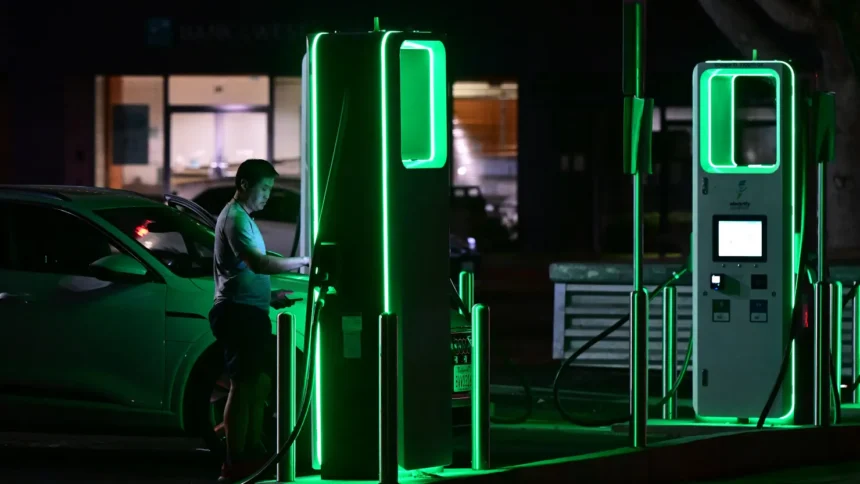
From here, execution will matter more than promises. Charging availability, financing costs and credible value propositions will determine whether EV demand stabilizes or continues to stall. In NewsTrackerToday’s view, the next phase favors automakers that treat electrification as an adaptive strategy rather than a doctrine. The long-term trajectory still points toward electric vehicles, but the path now runs through hybrids, disciplined investment and products that win on economics, not intention.