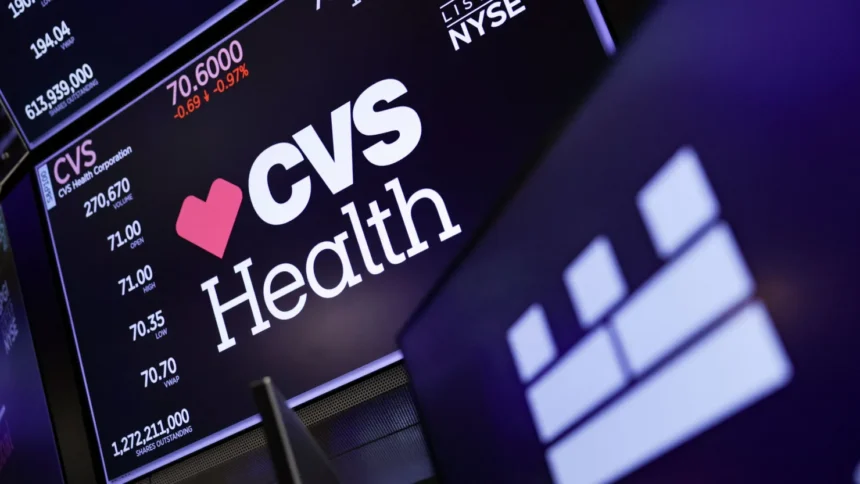
CVS Health delivered a decisive earnings beat in the first quarter, lifting full-year guidance as momentum returned to its insurance arm and reinforced confidence in a broader operational reset. The upgraded outlook – now targeting up to $7.50 per share and at least $405 billion in revenue – reflects improving execution across divisions, a shift that NewsTrackerToday frames as a turning point in the company’s recovery trajectory.
Investor attention has concentrated on the performance of Aetna, long pressured by elevated medical costs. Revenue in the insurance segment exceeded expectations while profitability metrics improved, signaling tighter control over claims relative to premiums. The medical benefit ratio dropped to 84.6%, indicating stronger margin discipline even as healthcare utilization remains elevated across Medicare Advantage populations.
Beyond insurance, the company’s diversified structure provided additional stability. Retail pharmacy operations held steady, while the health services division – anchored by Caremark – expanded at a double-digit pace, reflecting growing demand for cost management solutions in prescription drug distribution. Within this broader context, NewsTrackerToday outlines how CVS leverages its integrated model to balance volatility across business lines and maintain consistent earnings momentum. Ethan Cole, a specialist in macroeconomics and central banks, interprets the improvement as part of a broader recalibration across U.S. healthcare systems, where insurers increasingly prioritize pricing discipline and selective market participation. Strategic exits from unprofitable plans and tighter benefit structures emerge as deliberate adjustments rather than temporary fixes. These changes, while potentially limiting membership growth, reinforce profitability and reduce exposure to unpredictable claims cycles.
Operational restructuring has also played a defining role. Cost reductions, store closures, and internal efficiency programs have reshaped expense structures, allowing the company to absorb persistent cost pressures without eroding margins. At the same time, NewsTrackerToday draws attention to how these internal levers – rather than external demand shifts – have driven the bulk of recent earnings upside. Liam Anderson, a financial markets expert, views the stock’s upward reaction as a reassessment of risk rather than pure enthusiasm. He highlights that consistent “beat and raise” performance rebuilds investor confidence, particularly in sectors where earnings visibility has been fragile. The absence of unexpected cost spikes further strengthens the perception that management has regained control over forecasting.
Medical cost pressure remains a structural challenge, yet the direction of travel suggests adaptation rather than strain. With clearer forecasting, disciplined underwriting, and diversified revenue streams, CVS appears to be moving into a more stable growth phase – a transition News Tracker Today emphasizes as increasingly significant for long-term positioning within the healthcare sector.