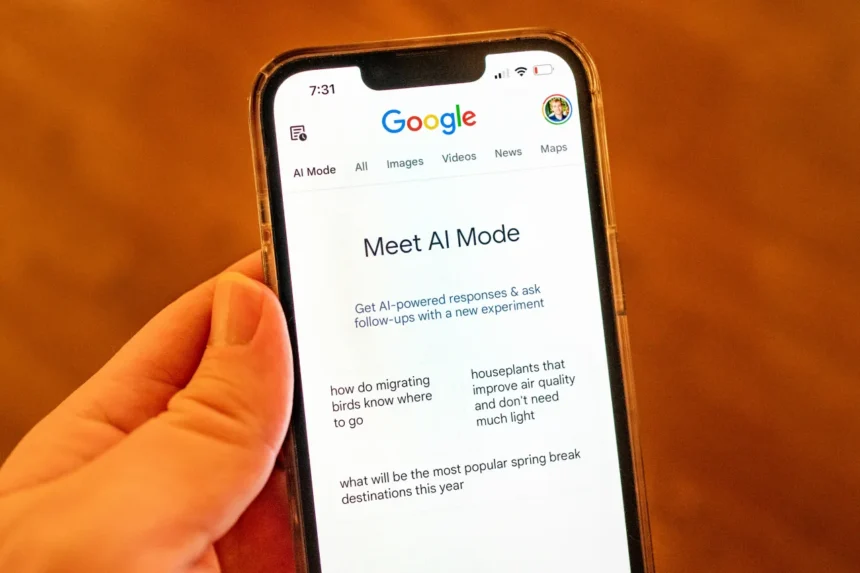
A few years ago, search engines simply answered questions. Today, they are beginning to act on them. Google’s latest update to AI Mode signals a profound shift: the company isn’t just improving search, it is redefining it. The new agent-style capabilities turn Search from a gateway to information into a transaction engine, capable of finding tickets, booking tables and scheduling appointments directly. At NewsTrackerToday, we see this move as the clearest indicator yet that the internet is evolving from a directory into an operational layer of the real economy.
With the update, users in the U.S. testing via Search Labs can now offload tasks like securing restaurant reservations, buying event tickets or booking wellness services. A prompt such as: “Find me two affordable standing tickets for an upcoming Shaboozey concert” triggers live price checks across booking platforms, followed by a direct link to complete the purchase. Restaurant requests follow the same logic: specify guests, time, location and cuisine – say, “table for three after 6pm near Logan Square for ramen or bibimbap” – and the system returns curated options based on real-time availability.
Google emphasizes this is still an experiment, warning of potential inaccuracies, though premium subscribers receive higher usage limits. The feature builds atop AI Mode’s rapid expansion to more than 180 countries and its growing toolkit: multimodal input, Canvas for lesson planning and structured workflows, and Google Lens to query what’s on your screen.
For markets, this shift is strategic. Liam Anderson, financial markets analyst at NewsTrackerToday, notes: “Google is transforming search from an information product into a service product. Monetization follows behavior – and if actions stay inside the ecosystem, Google captures the value end-to-end.” In other words, instead of earning from clicks, Google aims to own the entire customer journey, from intent to execution.
This evolution also reflects competitive pressure. New entrants like Perplexity and OpenAI’s search have reframed expectations around interface and intelligence – users increasingly expect dialogue, personalization, and agent-style automation. Isabella Moretti, M&A strategist at NewsTrackerToday, sees a defensive-offensive hybrid move: “Google isn’t defending its dominance by freezing the past. It’s building the next layer of the search economy – where the interface stops being a query box and becomes a personal operations assistant.”
Yet the opportunity comes with risk. When a system transitions from suggesting to doing, accountability rises. A mismatched concert ticket is an annoyance, but a failed medical booking becomes an issue of trust. Historically, search transitions – from links to rich snippets, from desktop to mobile – reshaped entire industries. This shift may move even faster.
We believe agentic capabilities will soon become the competitive frontier among AI platforms. The default expectation will evolve from “tell me” to “do it for me.” Success will depend on accuracy, transparency and the ability to balance automation with user agency.
Businesses should begin structuring their systems and data for automated transaction flows; consumers should treat the system as powerful but still learning; regulators will need to monitor an environment where one platform could orchestrate both search and commerce.
Google is no longer helping users find what they need – it is beginning to do what they need. As we at News Tracker Today emphasize, those who understand how to plug into this new operating paradigm early will capture the value in the next era of digital competition.