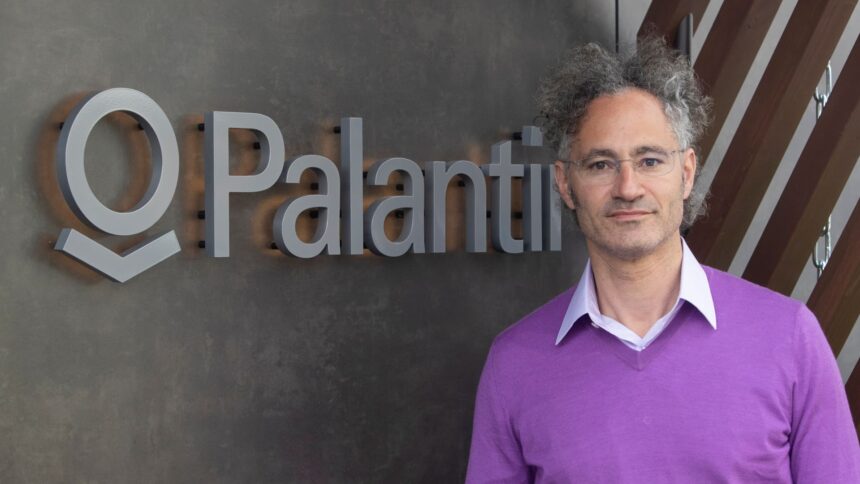
November turned into the kind of month for Palantir when market sentiment diverged sharply from business performance. Despite a strong quarter, new multiyear deals, and accelerating adoption of its AI platform AIP, the company’s shares suffered their worst decline since 2023 – dropping roughly 16%. At NewsTrackerToday, we see this not as a crisis of operations, but as a crisis of valuation: the stock had been priced for perfection for too long.
The month started on an optimistic note. Palantir posted its second consecutive quarter above the $1 billion revenue mark, with U.S. commercial AI demand growing rapidly. Yet the bright headlines were quickly overshadowed by the sector-wide fear of overvaluation. Jefferies labeled Palantir’s multiples “extreme,” RBC warned of a highly concentrated growth profile, and Deutsche Bank noted that the stock’s pricing “defies traditional models.”
As NewsTrackerToday analyst Liam Anderson put it, the selloff was almost inevitable: “When a stock trades at more than 200 times forward earnings, it stops responding to fundamentals and starts responding to sentiment. Any hint of uncertainty turns even a strong quarter into a reason to sell.”
Michael Burry added fuel to the correction. The investor famous for predicting the 2008 crisis increased short bets against Palantir and Nvidia, hinting at an emerging “AI bubble.” His criticism targeted hyperscalers and accounting practices rather than Palantir’s product – but the psychological impact rippled across the sector. CEO Alex Karp responded combatively, appearing twice on CNBC in one week, accusing Burry of “market manipulation” and calling bearish bets on AI “utter nonsense.” His emotional pushback, however, did not reverse the trend.
Across tech, high-valuation names slumped. Nvidia fell more than 12%, quantum-computing stocks collapsed by a third, and within the “Magnificent Seven,” only Apple and Alphabet ended the month in positive territory. In such an environment, even Palantir’s tangible achievements struggled to influence sentiment.
The company secured a major multiyear partnership with PwC UK to accelerate AI adoption across British enterprises, and signed a deal with FTAI Aviation to use Palantir’s software to optimize jet engine maintenance and supply chains. These contracts signal deepening integration into critical corporate infrastructure.
As Isabella Moretti, corporate strategy analyst at NewsTrackerToday, noted: “These aren’t hype-driven announcements. They show Palantir embedding itself into the operational core of its clients. That kind of presence can reshape performance, not just storytelling.”
Still, the central question lingers: does the valuation match the trajectory? Even after the selloff, Palantir trades at roughly 233× forward earnings – compared with 38× for Nvidia and 30× for Alphabet. Such pricing demands years of flawless execution, something markets rarely grant without hesitation.
From the perspective of News Tracker Today, November wasn’t a collapse – it was a recalibration. The fundamentals look solid, commercial AI momentum is real, but investors are no longer willing to pay any price for a promising narrative. For long-term investors, Palantir remains a high-potential, high-volatility opportunity. For those seeking exposure to AI with less risk, diversified giants like Microsoft and Alphabet offer a steadier path.
Palantir may still become one of the defining platforms of corporate AI, but the market has made its stance clear: future growth must be earned through sustained performance, not just vision.