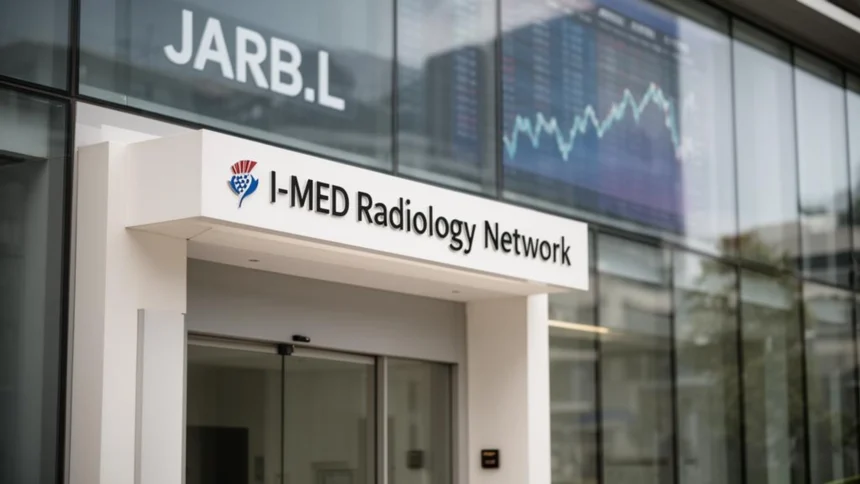
Jardine Matheson announced on Monday it has agreed to acquire I-MED Radiology Network, Australia’s largest private medical imaging provider, for a total enterprise value of A$3.4 billion, or approximately $2.4 billion U.S. The seller is Permira, the London-based private equity firm that held I-MED since 2018. The buyer is one of Asia’s most storied conglomerates, whose portfolio already spans property, retail, motor vehicles, and hospitality. Adding a 215-clinic radiology network to that list is not obvious diversification – and it is precisely that gap between the surface read and the actual logic that NewsTrackerToday unpacked when the deal announcement landed. The strategic logic sits in what comes with I-MED: a minority stake in Harrison.ai, an Australian company building AI-powered radiology interpretation tools. That is the part of this deal the headline price does not fully capture.
I-MED performs more than 7 million diagnostic imaging procedures annually across Australia and New Zealand, and provides teleradiology services in both countries as well as the U.S. The transaction values the business at approximately 11.5 times forecast adjusted EBITDA for the year ending June 2026, excluding the Harrison.ai stake, according to Jardines’ statement. Lincoln Pan, Jardines’ CEO who started in the role in December, described I-MED as ‘already a market leader in radiology today’ and pointed to expansion into new markets as the rationale. Pan also completed Jardines’ Mandarin Oriental buyout in January, signaling a pattern of control-oriented acquisitions in sectors with defensible market positions. The Harrison.ai layer is what NewsTrackerToday noted as the underpublicized dimension of this transaction.
Harrison.ai builds AI tools specifically for radiology workflow. Its Annalise platform assists radiologists by flagging findings across chest X-rays, CT scans, and other modalities, with the goal of reducing read time and increasing detection rates. The company has published clinical validation data and counts public health systems among its clients. For Jardine Matheson, acquiring control of I-MED includes inheriting whatever equity position I-MED holds in Harrison.ai, meaning Jardines gains not just a diagnostics network but a direct interest in the AI layer that could eventually augment a significant portion of I-MED’s own volume. That is a different kind of infrastructure investment than buying a hotel chain.
Isabella Moretti, who covers corporate strategy and M&A, examines the deal mechanics: “11.5 times EBITDA for a private radiology network is a full price but not extraordinary for a market-leading asset with regulatory moats and recurring procedure volume. The Harrison.ai stake is effectively a free option on the upside case, and private equity sellers always retain optionality like that for a reason. What I’d watch is whether Jardines moves to consolidate its Harrison.ai stake over the next 18 to 24 months – either through secondary purchases or a direct investment round. If they do, this acquisition reprices as a tech bet dressed in healthcare clothing.” The way Jardines framed the Harrison.ai interest in its own deal statement is what NewsTrackerToday read as deliberate rather than incidental – the AI stake appeared not as a footnote but as a named strategic fit marker.
Daniel Wu draws the geopolitical frame: “Asian conglomerates pivoting from property and retail into healthcare data infrastructure is a pattern worth watching. I-MED’s teleradiology operations in the U.S. give Jardines a foothold in the world’s largest healthcare market. Combine that with AI-assisted diagnostics and you have a data asset that becomes more valuable the more scans it processes. The question is always whether regulators in the target market see the data dimension the way the acquirer does.” Australian foreign investment rules require approval for this transaction, and regulatory review of healthcare data assets involving foreign ownership has tightened in multiple jurisdictions since 2023. That risk sits as the meaningful variable between signing and closing.
The deal is expected to close later in 2026, pending regulatory approvals. Jardines confirmed funding through cash reserves and debt without specifying the split. As a conglomerate with diversified cash flows and a history of patient capital deployment, Jardines can absorb the leverage. The more interesting projection is what the asset looks like in five years if Harrison.ai’s radiology AI reaches clinical deployment at scale across I-MED’s network. A business that today processes 7 million procedures a year with human radiologists starts to look quite different with AI augmentation at the front end of every read. That is the scenario Jardines is paying 11.5 times EBITDA to be positioned for, and it is the scenario that the Harrison.ai stake – as News Tracker Today laid out – makes intelligible as a strategic thesis rather than a premium overpay.