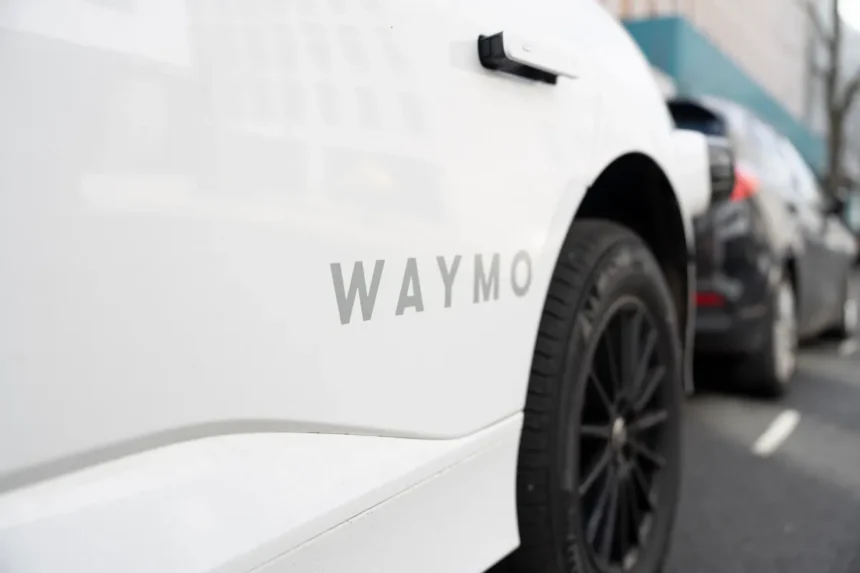
Waymo has begun autonomous vehicle testing on public roads in London, marking a critical step toward launching a commercial robotaxi service in the city. The move signals a broader international expansion strategy, and as NewsTrackerToday notes early in this rollout phase, London may become the company’s first large-scale market outside the United States.
The testing program currently involves around 100 all-electric Jaguar I-Pace vehicles equipped with Waymo’s self-driving system, each still supervised by a human safety operator. These vehicles operate across a roughly 100-square-mile area, following months of manual mapping conducted by Waymo employees. This phased approach mirrors the company’s deployment playbook in U.S. cities, where gradual scaling has reduced operational risk while refining system performance.
London presents a uniquely complex environment. Narrow streets, unpredictable traffic patterns, and dense pedestrian activity challenge autonomous systems far more than the grid-like layouts of cities such as Phoenix. Sophie Leclerc, a technology sector specialist, highlights that urban adaptability – not just raw AI capability – determines whether autonomous fleets can scale profitably in European capitals. In this context, NewsTrackerToday frames the London tests as less about expansion and more about validation under real-world constraints.
Regulatory uncertainty remains the decisive factor. Full driverless operation requires final approval from U.K. authorities, and timelines remain fluid. Waymo’s collaboration with emergency services and local hiring efforts suggests a strategy focused on building institutional trust alongside technical readiness. This dual-track approach reflects lessons learned in the U.S., where regulatory friction often slowed deployment even after technical milestones were reached. Observations within NewsTrackerToday coverage suggest that regulatory alignment may shape competitive advantage more than technology itself in this phase of the market.
Competition is intensifying. U.K.-based Wayve, in partnership with Uber and Nissan, is preparing its own autonomous rollout, while parallel testing in Tokyo indicates a broader race for early dominance in global cities. Isabella Moretti, specializing in corporate strategy and M&A, points out that first-mover advantage in mobility platforms tends to compound over time – early entrants capture not just users, but also data, partnerships, and regulatory familiarity that are difficult to replicate later.
Waymo’s existing scale strengthens its position. With more than 3,000 robotaxis already deployed across 11 U.S. cities, the company operates one of the largest autonomous fleets globally. Its prior acquisition of the U.K.-based startup Latent Logic and the establishment of an engineering hub in Oxford further anchor its European ambitions, providing localized expertise in simulation and machine learning.
London now becomes a proving ground where technology, regulation, and competition intersect. The outcome will likely define not only Waymo’s international trajectory but also the pace at which autonomous mobility becomes a mainstream urban service. As News Tracker Today emphasizes in its ongoing analysis, the transition from testing to commercial viability in cities like London may determine who leads the next phase of transportation infrastructure.