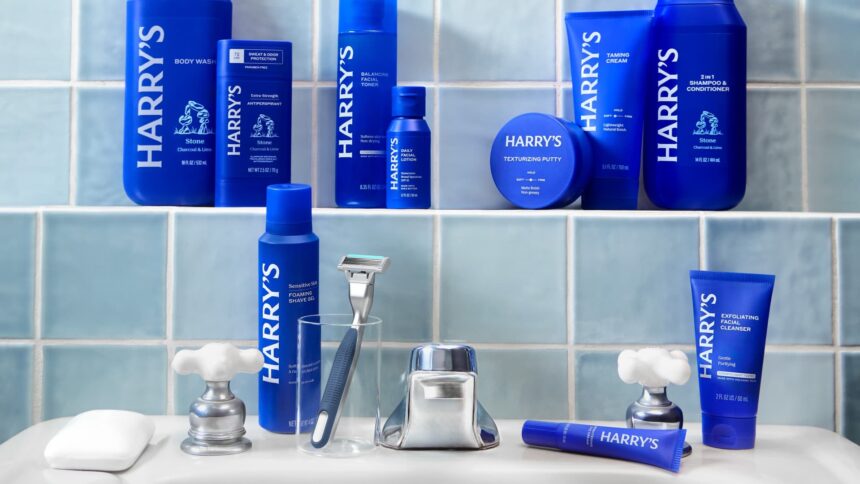
Mammoth Brands, the New York-based consumer packaged goods company whose portfolio includes Harry’s razors, Lume Deodorant, Flamingo, Mando, and Coterie diapers, has built a business that its co-CEOs describe with specific ambition: “If Procter & Gamble and Unilever were getting built today,” Andy Katz-Mayfield told CNBC in an interview, “that’s what we’re trying to do.” Revenue reached $835 million in 2024 with nearly $100 million in adjusted EBITDA, and the company has compounded at more than 20% annually over the prior five years. Those numbers, and the IPO that sources familiar with the matter say the company is weighing as soon as the second half of 2026, are what NewsTrackerToday flagged as the clearest test yet of whether the direct-to-consumer brand-building model of the past decade can still command a public-market premium in a consumer environment where heritage CPG companies are not exactly struggling.
The Mammoth portfolio is deliberately spread across multiple personal care and baby care categories. Harry’s, the razor brand Katz-Mayfield and co-CEO Jeff Raider founded in 2013, was the original vehicle. Lume, a natural deodorant acquired in 2021, more than doubled in size within two years under Mammoth’s retail infrastructure. Coterie, the premium diaper brand acquired from private equity in October 2025, had crossed $200 million in annualized revenue before the deal closed, growing at nearly 60% year-on-year, and now extends Mammoth into the $12 billion U.S. diaper, training pants, and wipes market. The acquisition mechanism, which Mammoth describes as Mammoth Labs, focuses specifically on buying DTC-first brands before they have fully scaled in retail, which the company treats as a genuine competitive edge.
Isabella Moretti examines the deal architecture precisely: “Mammoth raised approximately $950 million across its funding history, including Bain Capital as a lead investor. At $835 million in revenue and $100 million in EBITDA, the business trades at a meaningful EBITDA margin relative to its stage. The IPO question is whether public market investors value this as a premium CPG growth story at 15 to 20 times EBITDA, or as a mid-market consumer company with DTC exposure in categories that face Procter & Gamble shelf resets whenever P&G decides a challenger brand has gotten too large. The Coterie acquisition timing also matters: integrating a brand growing at 60% into the Mammoth infrastructure while simultaneously preparing an S-1 is operationally demanding.” The integration risk and the IPO timing are what NewsTrackerToday ran through as the two variables that sit between the headline revenue number and the valuation the company will seek.
Katz-Mayfield was directly asked about the IPO timing in the CNBC interview and responded with a pointed “don’t know where that came from.” He then added that the company makes money and can use that cash flow, which is a careful way to signal financial independence without confirming or denying any public offering timeline. The phrasing matters in pre-IPO context: companies weighing a public listing communicate through what they do not say as much as through what they do, and both the interview’s existence and its content confirm that Mammoth is at minimum comfortable having its numbers publicly discussed.
Liam Anderson reads the market positioning directly: “Harry’s tried to sell to Edgewell in 2019 and the FTC blocked it. This is the next chapter. DTC brand rolls up into a multi-category CPG, builds EBITDA, goes public. The question is multiple. Procter & Gamble trades at 20-plus times earnings. Unilever trades at 15. A challenger CPG at $835 million in revenue with 20% CAGR could reasonably seek a growth premium, but the consumer is cautious right now and IPO windows are weather-dependent.” The IPO market context heading into H2 2026 includes several high-profile listings competing for investor attention, which is what NewsTrackerToday put on record as the environmental variable that Mammoth cannot control.
Mammoth’s CPG competitors have had time to adjust since Harry’s first disrupted the razor category. Gillette and Dollar Shave Club both responded with lower-priced alternatives and digital marketing budgets that now rival DTC brands on social platforms. Lume competes with Dove and Schmidt’s, both of which sit inside Unilever. The Coterie diaper play pits the company against Pampers and Huggies, whose combined hold on U.S. retail shelf space has endured every challenger for four decades. Whether those categories remain disruption-ready or have already absorbed the DTC lesson is what News Tracker Today reads as the central competitive question the IPO prospectus will need to answer for institutional buyers.