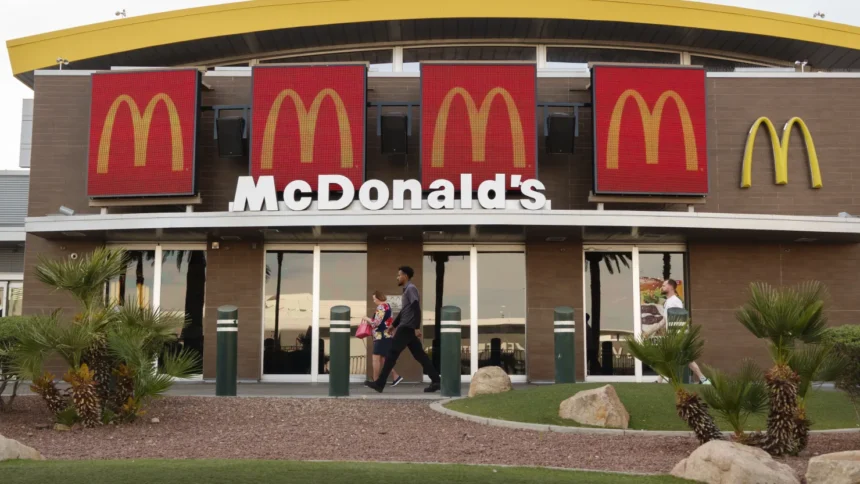
McDonald’s doesn’t launch global strategies quietly. On Monday, at its biennial Worldwide Convention in Las Vegas – the event gathering franchisees, suppliers, and employees – the world’s largest fast-food chain unveiled its new growth plan, called McDonald’s > NEXT. The announcement replaces Accelerating the Arches – a strategy that, as NewsTrackerToday broke down at launch, had been guided by three pillars since late 2020 through pandemic recovery, digital channel expansion, and a drive-thru build-out. That plan ran its course. This one raises different questions about what McDonald’s needs to become in a market that has shifted considerably since 2020.
The four pillars of McDonald’s > NEXT are clean on paper: menu innovation, deeper consumer connections, improved restaurant efficiency, and a rethought approach to service and hospitality. Global chief restaurant experience officer Jill McDonald stated the direction directly: the company is targeting chicken, beef, and beverages as its growth categories, acknowledging that Chick-fil-A and Raising Cane’s have pulled chicken-focused diners away over several years. A pilot of bone-in wings is underway. The McCrispy platform is extending. Beverages – where 7 Brew Drive Thru Coffee and specialty chains have been taking McDonald’s transaction share – are getting dedicated innovation resources, inspired partly by the cultural-moment success of the Grimace Shake campaign. Consumer-led development, not corporate-led development, is the stated new direction for McDonald’s product pipeline.
The automation piece is where the announcement gets structurally interesting. A system called ARCHY is running at five U.S. locations, handling automated ordering and freeing staff for other tasks. A redesigned restaurant prototype accompanies the plan, aimed at simplifying back-of-house operations and reducing shift complexity for crew. Five pilot sites is a validation gate, not a rollout commitment, which NewsTrackerToday zeroed in on as the key distinction between McDonald’s announcement and an actual deployment plan: but McDonald’s operates more than 40,000 locations globally. Even a modest per-transaction labor cost improvement compounds into a number that funds the rest of the strategy multiple times over. That is the math franchisees will be watching before any wider ARCHY commitment.
Isabella Moretti laid out the unit economics argument: “If ARCHY reduces labor cost per transaction by 8 to 10% at scale, the compounding effect across 40,000-plus locations materially changes franchisee EBITDA. That is the data point franchisees will be studying before the investor day in September – not the menu headlines.”
Daniel Wu brought the historical rhythm, in a read that News Tracker Today tracked across the company’s three prior reinvention cycles: “McDonald’s has reinvented its operating model three times since the 1990s – around real estate rationalization, supply chain standardization, and digital-delivery expansion. Each reinvention extended the competitive runway by roughly a decade. The question is whether ARCHY plus menu diversification constitute the fourth reinvention, or whether they are defensive maintenance against fast-casual pressure that is not going to slow down on its own.”
Bear in mind where the company stands entering McDonald’s > NEXT. Four consecutive quarters of comparable sales growth through early 2026. CEO Chris Kempczinski targeting 50,000 global restaurants, which would reclaim the unit-count title from Subway. Detailed financial targets arrive at a dedicated investor event in September – a deliberate three-month gap between announcement and metrics. The conviction behind the plan is real. Whether it arrives early enough to stay ahead of the competitive pressure building around it is what September will start to answer.
And one more variable is worth tracking: consumer spending conditions. McDonald’s built Accelerating the Arches when pandemic-era savings supported restaurant visits even as prices rose. The consumer entering McDonald’s > NEXT is more price-sensitive, with lower-income diners already pulling back. The strategy’s menu and hospitality pillars address that directly. But the value perception battle is ongoing – and competitors are not standing still. September’s investor day, NewsTrackerToday noted, will tell us whether McDonald’s has a financial model that fits 2026 consumer reality, or a plan designed for conditions that no longer fully hold.