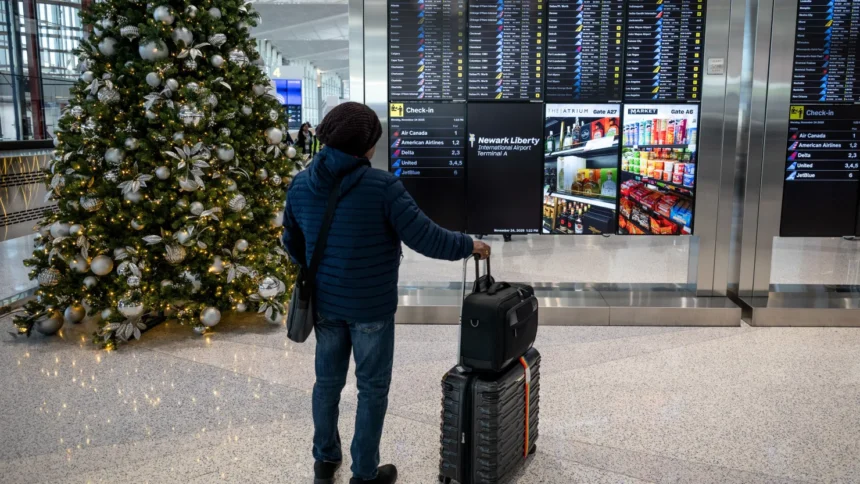
At NewsTrackerToday, we note that U.S. airlines are entering one of the most operationally sensitive periods of the year as a powerful winter storm targets the New York–New Jersey–Philadelphia corridor during the holiday travel rush. With heavy snowfall expected to accumulate rapidly overnight, carriers are moving preemptively, relying on flexibility rather than spare capacity to protect their networks.
Major airlines including Delta Air Lines, United Airlines, Southwest Airlines, JetBlue Airways, and American Airlines have expanded travel waivers, allowing passengers to change dates without fees or fare differences on affected routes. The highest exposure is concentrated around key hubs such as John F. Kennedy International Airport, Newark Liberty International Airport, and Philadelphia International Airport, where even minor ground delays can quickly cascade across national schedules.
From an operational perspective, NewsTrackerToday views these waivers as a defensive necessity rather than a customer-friendly bonus. Liam Anderson, who specializes in airline operations and network resilience, observes that encouraging passengers to rebook ahead of time is often the most cost-effective way to manage winter disruptions. By smoothing demand before snowfall peaks, airlines reduce the risk of mass cancellations, crew displacement, and multi-day recovery cycles.
The timing amplifies the risk. U.S. carriers are operating with minimal slack during the holiday period, when aircraft utilization is high and available seats for rebooking are scarce. NewsTrackerToday emphasizes that storms during peak travel weeks rarely remain local events: congestion in the Northeast frequently spills into the Midwest and West Coast within hours, even when weather elsewhere is clear.
For travelers, the main threat is not just delay but compounding disruption. Sophie Leclerc, whose focus is consumer behavior and digital travel platforms, notes that passengers who act early typically retain more control over routing and timing, while those who wait face shrinking options as airlines prioritize system recovery over individual preferences.
Isabella Moretti, specializing in corporate strategy and transportation economics, adds that repeated stress tests like this increasingly shape how investors evaluate airlines. Reliability during peak disruptions influences long-term brand perception and revenue stability, not just quarterly cost performance.
The broader conclusion at News Tracker Today is that winter storms during holiday peaks are no longer exceptional shocks but predictable operational trials. Airlines that actively manage demand and communicate clearly can contain both financial and reputational fallout, while passengers who treat holiday travel plans as flexible rather than fixed remain best positioned to reach their destinations before year-end.