Meta Platforms is accelerating its investment in custom artificial intelligence hardware, unveiling a new generation of internally designed chips intended to improve efficiency across its rapidly expanding data-center network. The company introduced four proprietary processors as part of its Meta Training and Inference Accelerator (MTIA) program, a family of chips designed to support AI workloads across Meta’s platforms. According to NewsTrackerToday, the initiative reflects a broader strategy to reduce reliance on external suppliers while scaling computing infrastructure for growing AI demand.
The MTIA program was first introduced publicly in 2023, followed by a second generation in 2024. The new lineup expands the architecture with processors targeting different operational AI tasks. Meta designs the chips internally, while manufacturing is handled by Taiwan Semiconductor Manufacturing Company (TSMC).
Yi-Jiun Song, Meta’s vice president of engineering, said the company is focusing on specialized silicon that improves efficiency within its data centers while diversifying supply chains. By developing proprietary processors, Meta can tailor hardware to its own AI workloads rather than relying solely on general-purpose chips.
The first chip in the new group, MTIA 300, was deployed several weeks ago and is designed to train smaller AI models responsible for recommendation and ranking systems. These systems determine which posts, advertisements, and content appear across Meta’s services, including Facebook and Instagram. Sophie Leclerc, technology sector analyst at NewsTrackerToday, notes that recommendation engines represent one of the most resource-intensive workloads within social media ecosystems. In her view, optimizing chips for these tasks can significantly improve operational efficiency as digital platforms expand their AI capabilities.
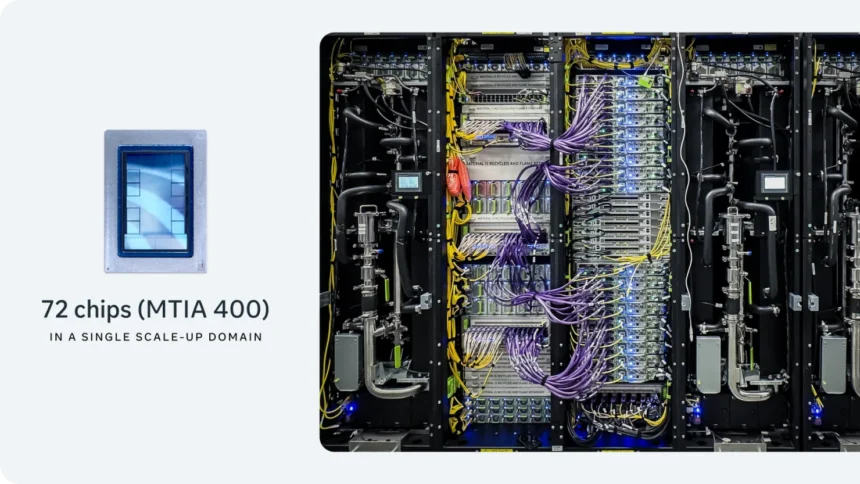
Three additional processors – MTIA 400, MTIA 450, and MTIA 500 – are designed for generative AI tasks such as image and video creation based on user prompts. Meta has completed testing of the MTIA 400 and plans to deploy it in its data centers, while the remaining chips are expected to enter operation around 2027.
The company indicated that these processors will primarily support inference and generative workloads rather than training massive language models. As NewsTrackerToday notes, technology companies are increasingly distinguishing between hardware optimized for model training and chips designed for operational AI tasks. Meta is currently developing new processors at an unusually rapid pace – roughly one every six months – reflecting the scale of its investment in AI infrastructure and the need to continuously deploy more advanced computing systems.
These hardware efforts are closely linked to Meta’s expanding data-center network. The company is constructing a large facility in Louisiana along with additional projects in Ohio and Indiana as part of a multi-billion-dollar AI infrastructure strategy. Daniel Wu, geopolitics and energy analyst, notes that the expansion of AI data centers is increasingly tied to energy availability and semiconductor supply chains. In his assessment, the concentration of new facilities in the United States reflects logistical advantages and access to large energy resources.
Meta’s move into custom chips mirrors strategies pursued by other technology giants. Companies such as Google and Amazon have spent years developing specialized processors known as application-specific integrated circuits (ASICs), which are optimized for particular workloads and can operate more efficiently than general-purpose GPUs.
At the same time, Meta continues to rely heavily on external hardware suppliers. The company recently secured agreements to deploy millions of Nvidia GPUs and up to six gigawatts of AMD GPU capacity across its data centers over the coming years. From a broader industry perspective, News Tracker Today highlights that the rapid expansion of AI infrastructure is intensifying demand for advanced semiconductor components, particularly high-bandwidth memory (HBM), a critical element in AI computing systems.
Manufacturers such as Samsung, SK Hynix, and Micron dominate the HBM market, and supply constraints remain a potential challenge as AI investments accelerate. As technology companies compete to build increasingly powerful AI infrastructure, NewsTrackerToday notes that control over specialized hardware is becoming a key factor shaping the next phase of competition in the global technology sector.