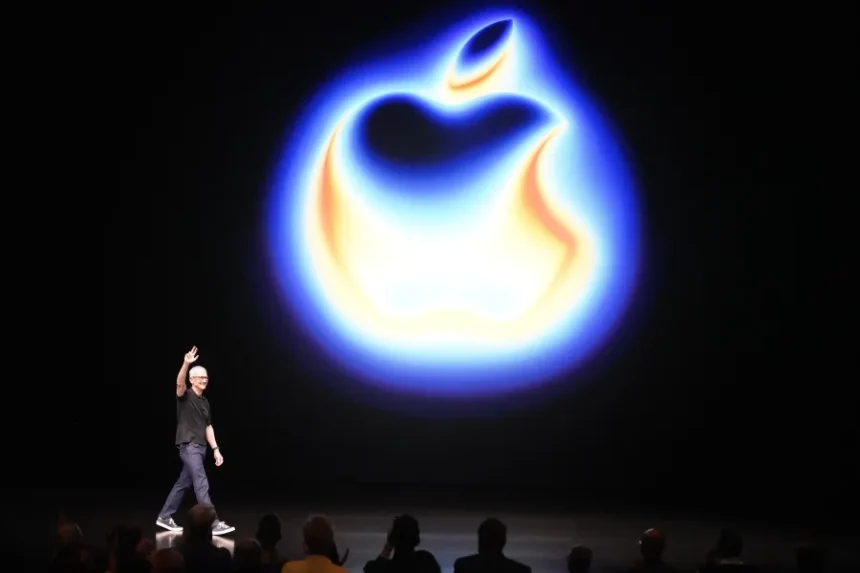
Tim Cook said in an interview published this week that iPhone price increases are “unavoidable” and that Apple has tried to shield customers from memory chip cost increases that the company itself can no longer absorb. “We’re doing our best to mitigate the huge increases that are being passed to us, and we’ve been trying to shield our customers from the increases, but the situation has become unsustainable,” Cook said. The specific mechanism he named is DRAM: more of it is now going into AI servers than in prior years, which has tightened supply for consumer devices at exactly the moment when smartphones, tablets, and computers need more of it to run on-device AI. Cook described the situation as a “hundred-year flood.” The Mac Mini’s price already rose approximately $200 this year as a preview of what’s coming. Apple device sales still grew 17% in the first three months of 2026, suggesting the demand floor is holding.
The supply dynamics Cook described are not new to the AI industry but have not previously hit Apple’s consumer product pricing this directly. High-bandwidth memory for AI servers – the HBM3E and HBM4 variants that SK Hynix, Samsung, and Micron produce for Nvidia’s GPU clusters – draws from the same underlying DRAM fab capacity that produces the LPDDR chips in iPhones and the DDR chips in Macs. When hyperscalers are building data centers at $725 billion annualized capex, they consume memory at a rate that leaves the consumer device market competing for what remains. The fourfold cost increase Cook cited describes chip prices that have quadrupled in roughly 12 months, a pace that even Apple’s supply chain sophistication and purchasing scale cannot fully insulate against. The specific trajectory and when it began bending against Apple’s margins is what NewsTrackerToday tracks as the material disclosure underneath the headline quotation.
Ethan Cole reads the economics concisely: “Memory chip costs up fourfold. Apple device sales up 17%. Those two numbers co-existing means Apple has been absorbing the margin compression rather than passing it through. The Mac Mini $200 hike was the first pass-through. The ‘unavoidable’ language is Cook signaling that the iPhone is next.” Supply chain experts who were asked about the price impact suggested the iPhone 17 Pro, which currently starts at $1,099, could see an increase of up to $270 to maintain Apple’s margin profile under the current memory cost structure. That would put the entry price for the Pro model close to $1,370. Whether a $270 increase on a flagship phone sustains Apple’s iPhone unit sales trajectory is a meaningful question given that the Chinese market, where Apple saw 25-to-30% comparable store growth through Siri AI adoption, is price-sensitive to premium SKU increases.
Sophie Leclerc, who covers the technology sector, places the AI cost pressure in the product architecture context: “Apple’s push to run more AI locally – Private Cloud Compute, on-device inference, the Foundation Models framework – is itself a memory consumption driver. Every iPhone 17 Pro running Siri AI with on-device context awareness uses more DRAM than the equivalent function running on a remote server. Apple’s AI strategy and its memory cost problem are not separate issues. The more successful Apple Intelligence becomes as a product, the more memory its devices need, and the more memory they need in a constrained supply environment, the harder it is to hold prices stable. Cook’s ‘unavoidable’ statement is accurate as a market description and also an implicit acknowledgment that the AI strategy has a hardware cost that the company cannot fully control.” The fourfold cost figure is what NewsTrackerToday holds as the number that connects Apple’s AI ambition to its pricing problem.
Cook will leave Apple as CEO in September, succeeded by John Ternus, who has already warned about the memory cost situation in an April interview. The succession adds a specific dimension to the pricing conversation: incoming CEO Ternus will inherit the iPhone 18 launch cycle in September, the question of which products get price increases first, and the task of managing customer expectations around a premium device brand raising its prices for a cost reason it does not fully control. Ternus warned about the same situation in April, indicating the incoming leadership has clear eyes on the problem. The Mac Mini’s $200 increase established consumer awareness of the cost pressure, which gives Apple some cover for extending price increases to other product lines. That precedent is what NewsTrackerToday puts the succession note against: Ternus inherits both the problem and the first piece of evidence that consumers can absorb the news.
The shift this week represents is the move from Cook warning about cost pressure in earnings calls to Cook publicly stating that price increases are unavoidable in a named interview. That transition from cautious guidance to explicit public commitment is the thing that changes the iPhone upgrade cycle calculus for consumers making decisions about whether to buy the iPhone 17 while it is priced at $1,099 or wait for the iPhone 18 that may price significantly higher. Some portion of that consumer base will accelerate their purchase to beat the increase. Some will defer until prices normalize. Both behaviors affect Apple’s near-term unit trajectory in ways that the 17% device sales growth rate does not yet reflect. The pricing decisions Ternus makes in the first 90 days of his tenure – the window that News Tracker Today reaches as the decisive test of the new CEO’s positioning instinct – will define whether this shift is managed gracefully or creates the kind of consumer backlash that Apple’s premium positioning has historically managed to avoid.