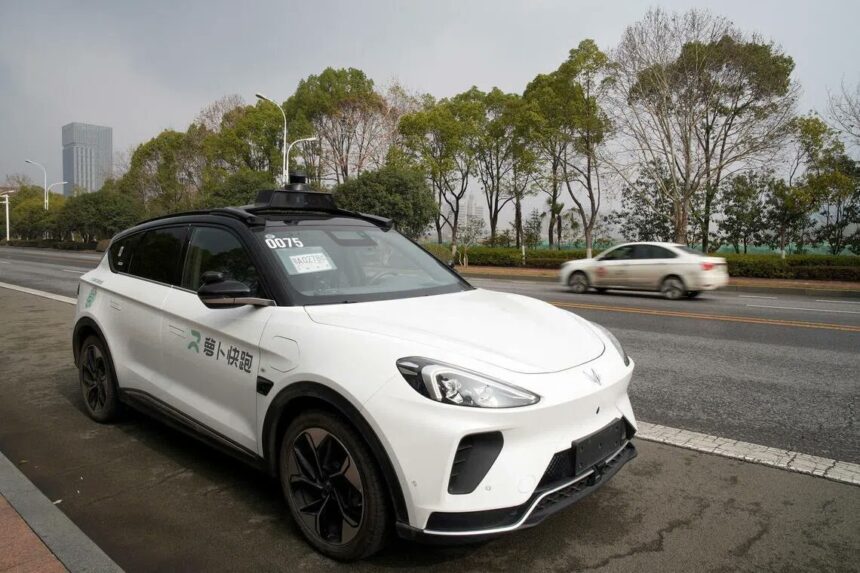
China has halted the issuance of new licenses for autonomous vehicles following a large-scale disruption involving Baidu’s Apollo Go fleet in Wuhan, where dozens of robotaxis simultaneously stalled and blocked traffic – a development that NewsTrackerToday places within a broader tightening of regulatory control over emerging AI-driven infrastructure. The incident, which left passengers stranded and triggered public concern, prompted multiple central agencies to convene with local authorities overseeing autonomous driving programs. Regulators instructed cities to reassess safety protocols and strengthen monitoring systems, signaling that operational reliability – not just technological advancement – is becoming the decisive factor in policy support. The suspension effectively prevents companies from expanding fleets, launching new pilots, or entering additional markets, introducing immediate constraints on industry momentum.
China’s robotaxi sector has been one of the most aggressive globally, with companies pushing toward large-scale deployment of Level 4 autonomous vehicles. Daniel Wu, who specializes in geopolitics and energy, interprets the regulatory response as part of a broader balancing act between technological leadership and domestic stability. Within that context, NewsTrackerToday points to the increasing sensitivity around infrastructure failures in densely populated urban environments, where even temporary disruptions can quickly escalate into systemic concerns.
The Wuhan incident also highlights the fragility of public trust. Earlier protests in the same city reflected anxiety over job displacement, particularly among traditional taxi drivers. That social dimension continues to shape policy decisions, as authorities weigh innovation against employment risks and public sentiment. Isabella Moretti, who focuses on corporate strategy and M&A, views the latest pause as a reminder that scaling autonomous mobility depends as much on societal acceptance as on engineering progress. Through this lens, NewsTrackerToday draws attention to the uneven pace of adoption, where regulatory cycles and public reaction can abruptly interrupt technological rollouts.
Market reactions underscore the immediate impact of the suspension. Shares of major players declined, reflecting investor concern over delayed expansion and uncertain timelines for regulatory approvals. Many of these companies remain unprofitable and heavily reliant on continuous deployment to justify capital-intensive development strategies. Interruptions in licensing therefore affect not only growth trajectories but also long-term financial viability.
The broader competitive landscape adds another layer of pressure. Chinese firms are racing to establish dominance in autonomous driving against international rivals, particularly in the United States. However, tighter domestic oversight may slow that momentum, even as it aims to ensure higher safety standards. News Tracker Today frames this moment as a recalibration phase – one where rapid scaling gives way to stricter validation, potentially reshaping how and where autonomous technologies achieve commercial maturity.