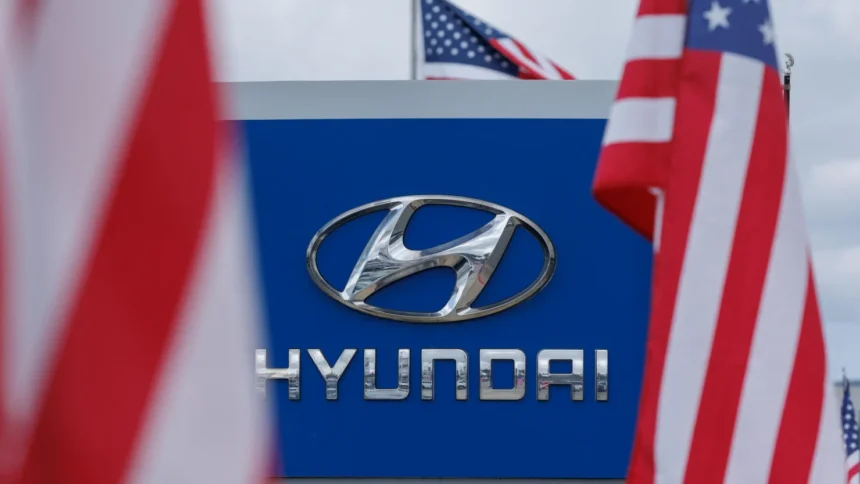
The U.S. decision to ease tariffs on South Korean auto imports arrived with little fanfare, yet within the global car industry it landed like a strategic tremor. For Hyundai Motor and General Motors – the two automakers most exposed to Korean import duties – the shift marks more than a financial reprieve. It signals a subtle rewriting of the trade architecture governing the world’s largest auto market. At NewsTrackerToday, we view this change not as a technical adjustment in rate sheets, but as an early marker of how Washington intends to recalibrate market access in an increasingly politicized era of industrial policy.
After months of tariff-driven pressure, the reduction from 25% to 15% offers meaningful breathing room. Hyundai, which absorbed roughly 1.8 trillion won in U.S. duties in the third quarter alone, and GM, which anticipated up to $4.5 billion in tariff exposure this year, now face a materially softer cost environment. As Liam Anderson, a financial-markets specialist, notes, “Any step that reduces tax drag on imports immediately reshapes liquidity for companies operating on high-volume, low-margin models.” For both manufacturers, even a modest easing frees capital that can be redirected toward product development, pricing strategy, or electrification initiatives.
Yet the structural picture remains complicated. Hyundai continues to import close to one million vehicles annually into the U.S., accounting for roughly 40% of its domestic sales, while GM increasingly relies on South Korean production to supply its entry-level crossover lineup. This dependency has already been tested by tariffs, currency volatility and, more recently, diplomatic friction following a high-profile immigration raid at a joint Hyundai–LG battery plant in Georgia. As we observe at NewsTrackerToday, the tariff relief softens the edge, but it does not eliminate the underlying vulnerability of globally distributed supply chains.
Washington, meanwhile, frames the decision as an investment in bilateral stability. South Korea recently advanced a parliamentary bill formalizing its pledge to invest $350 billion in the United States – a commitment U.S. officials have described as a cornerstone of “deepened economic trust.” But as Isabella Moretti, an analyst focused on corporate strategy and M&A, observes, “When trade concessions become currency in investment negotiations, companies must recognize that today’s relief may carry tomorrow’s conditionality.” Her point reflects a broader reality: in an age of industrial policy, tariff schedules can shift as quickly as political winds.
For Hyundai, which plans to localize more than 80% of its U.S. vehicle sales by 2030, the tariff adjustment acts as a bridge toward deeper domestic manufacturing. GM, by contrast, sees the reduced rate as a stabilizing force for an import-driven strategy that has powered its fastest-growing crossover segment. But both firms face the same strategic dilemma: how quickly must they reduce dependency on imported inventory to withstand future political, economic, or regulatory shocks?
Viewed through the lens of News Tracker Today, the implications are unmistakable. The tariff cut improves near-term earnings, but it does not resolve the long-term pressure points shaping the North American auto market. Electrification demands tighter integration between production and infrastructure. Consumers increasingly expect faster delivery cycles and transparent sourcing. And supply-chain disruptions – from geopolitics to labor raids – are no longer edge-case risks but recurring operational threats.
Investors should track three signals: capital expenditure shifts toward U.S. manufacturing, the pace at which import volumes decline, and whether automakers can maintain pricing power as tariff relief filters through the market. For Hyundai and GM, the current reprieve is meaningful – but temporary. The next phase of competition will reward companies that treat localization not as a political concession, but as a strategic moat.