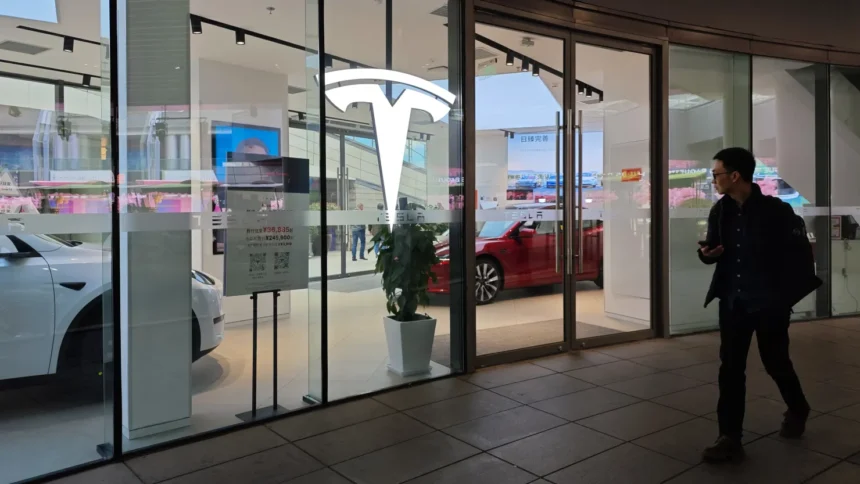
Tesla’s Shanghai Gigafactory records its strongest monthly output of 2026 in May, delivering 85,982 new energy vehicles – a year-on-year surge of 39.4 percent, a performance that NewsTrackerToday notes extends the company’s run of consecutive monthly growth to seven straight months. The figures, published by the China Passenger Car Association, cover both domestic Chinese deliveries and exports to Europe and other markets from the Lingang free-trade zone. The result marks a striking reversal from the weakness of a year ago, when intensifying domestic competition and Elon Musk’s public profile in Western markets were compressing Tesla’s volumes simultaneously.
The May figures fit into a broader sector recovery. Across China’s domestic electric vehicle manufacturers, 1.36 million passenger new energy vehicles sell in the month – a 12 percent gain year on year – prompting the CPCA to characterize the data as evidence of an initial recovery. BYD ends an eight-month streak of declining sales volumes, posting 376,990 deliveries, a symbolic 0.02 percent gain. Zeekr and Leapmotor both report surges exceeding 80 percent. Nio records a 62.3 percent year-on-year increase. Jessica Larn, a China automotive market specialist, notes that the breadth of May’s recovery across multiple brands reflects genuine underlying demand rather than one company gaining at another’s expense.
Xiaomi’s performance stands out as a signal of how rapidly new entrants scale. The technology giant delivers more than 30,000 EVs in May and launches the YU7 GT SUV – a performance variant that reportedly sets a lap record at the Nürburgring, establishing credibility where brand heritage traditionally matters. That a consumer electronics company positions a production SUV as a credible performance vehicle within two years of entering the automotive market illustrates the structural disruption still reshaping the industry. Tesla’s ability to maintain strong volume growth in this environment speaks to the resilience of its brand and the appeal of its Full Self-Driving roadmap. NewsTrackerToday connects this competitive intensity to the broader consolidation pressure continuing to reshape China’s crowded EV landscape.
On the demand stimulation front, Tesla deploys targeted financial engineering. In mid-May, the company introduces an Easy Loan financing structure in China: for a base rear-wheel-drive Model 3 priced at 235,500 yuan, the minimum down payment drops to 55,900 yuan – a reduction of approximately 30 percent – on a five-year term. The program targets budget-conscious buyers that competitors have aggressively courted with sub-200,000 yuan offerings. Tesla states it plans to further lower the threshold for more consumers, signaling that incentive deployment is not complete.
The international picture adds further texture. European markets post meaningful year-on-year growth in May, with France recording a surge of 655 percent, while Denmark, Spain, and Sweden also show healthy upticks. These gains are notable given the political sensitivity that Musk’s public profile created in European markets earlier in the year. The European recovery, driven primarily by vehicles exported from Shanghai, suggests that consumer sentiment normalizes and product appeal of the refreshed Model 3 and updated Model Y outweighs reputational headwinds in key markets.
A more complete picture of China-only retail performance arrives later in June when the CPCA publishes domestic-only sales data, stripping out exports. What May’s wholesale figures establish is that Tesla’s Shanghai operation functions as an effective global supply hub – producing for China and Europe simultaneously at volumes giving the company leverage few pure-play EV manufacturers can match. As NewsTrackerToday tracks in its ongoing EV market coverage, the combination of strong May results and an active consumer incentive program positions Tesla’s China business for a potentially robust second quarter.
The broader signal from May’s data is that the Chinese EV market is past its most acute post-incentive softness. What News Tracker Today identifies as the central tension in Tesla’s China story – maintaining volume against domestic brands competing primarily on price while preserving the brand positioning that justifies a premium – remains unresolved, but May’s data suggests the company holds its footing more securely than at any point in the past twelve months.