On Wednesday, the Federal Reserve will conclude its two-day policy meeting, and global markets are watching Washington with intense focus. The consensus among analysts is clear: the central bank is expected to cut its benchmark interest rate by another 25 basis points. Futures markets have already priced in this move with a 96% probability, reflecting strong confidence that the Fed will continue its gradual easing path.
At NewsTrackerToday, we see this not merely as another rate adjustment but as a critical attempt by the central bank to navigate an economy clouded by uncertainty, data scarcity, and political pressure. The ongoing government shutdown has deprived policymakers of key economic indicators, including labor market reports, forcing the Fed to act “partly blind.” As Ethan Cole, Chief Economic Analyst, explains: “For the first time in years, the Fed is operating in a statistical fog. This raises the risk of sending mixed signals to markets – a rate cut that’s too sharp could reignite inflation, while a hesitant move might undermine confidence in the dollar.”
The shortage of reliable data complicates both analysis and communication. After the payroll provider ADP ended its private data-sharing agreement with the Fed, one of the few tools for tracking real-time labor market conditions disappeared. Senator Elizabeth Warren has since demanded an explanation, accusing ADP of leaving the Fed “to fly blind.” Still, ADP’s public data shows a mixed picture: private sector jobs fell by 32,000 in September but are showing signs of recovery in early October estimates.
Inflation, meanwhile, remains modest. The consumer price index rose 3% year-over-year – lower than most forecasts – reinforcing arguments for a cautious easing of policy. We at NewsTrackerToday interpret the Fed’s approach as deliberately surgical rather than aggressive: Powell’s team is attempting to loosen credit conditions without destabilizing the dollar or signaling panic.
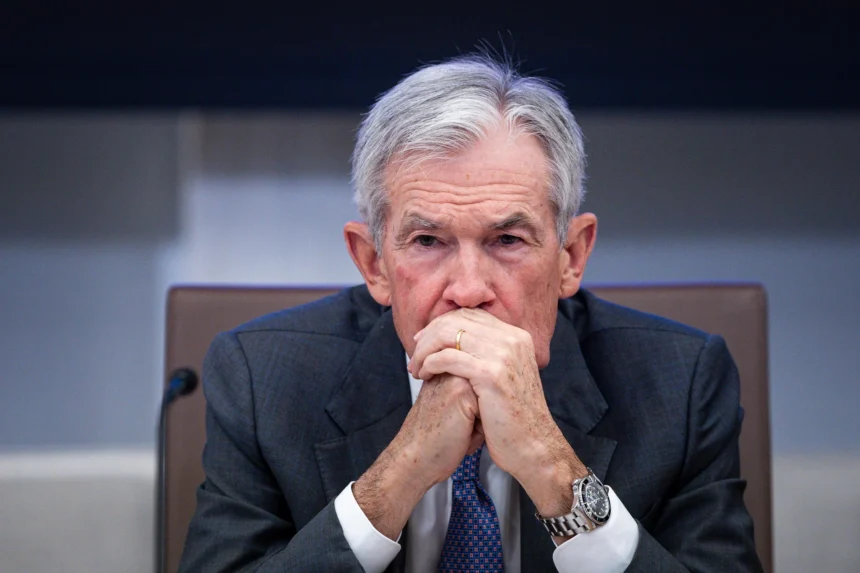
The Fed will announce its decision at 2:00 p.m. ET, followed by Chair Jerome Powell’s press conference at 2:30. His tone will likely define market sentiment for weeks ahead. President Donald Trump has repeatedly urged the Fed to move “faster and deeper” on rate cuts, arguing that the economy “needs acceleration,” but economists warn that excessive easing could reignite inflationary pressures.
For now, investors remain optimistic. Tech stocks are hovering near record highs – Apple’s market capitalization surpassed $4 trillion on Tuesday – while Treasury yields have adjusted in anticipation of looser monetary policy through year-end. Market futures also price in another 25 bp cut by December.
According to Technology Sector Analyst Sophie Leclerc, market optimism reflects more than faith in the Fed – it also reveals how deeply innovation industries depend on cheap capital. “For companies investing heavily in AI infrastructure, robotics, and semiconductors, access to low-cost liquidity is no longer optional – it’s existential. Monetary policy now influences the pace of technological progress as strongly as it once shaped industrial growth,” she notes.
We at NewsTrackerToday believe this week’s Fed meeting is pivotal not for the cut itself, but for the tone of Powell’s message. If the central bank signals that it intends to maintain a dovish course through the end of the year, markets are likely to rally further. But if his language turns cautious – hinting at a potential pause – a short-term correction could follow. Either way, the Fed’s priority remains clear: stabilizing financial flows while managing inflation expectations.
In the longer term, as Ethan Cole emphasizes, the U.S. economy is entering a phase of “managed deceleration” – a slow, deliberate rate reduction designed to cool inflation without triggering a recession. Powell’s challenge is to strike a delicate balance between stimulus and restraint, maintaining credibility in the eyes of global markets.
Looking ahead to December, investors will be watching whether the macro data – however limited – supports another rate cut. If inflation stays tame and labor indicators remain soft, the easing cycle is likely to continue.
Ultimately, as we conclude at News Tracker Today, this decision is more than a reaction to inflation – it’s a stress test of the Fed’s ability to act amid uncertainty. Global markets have already bet on a soft landing. The real question now is whether the Fed will validate those expectations – or surprise the world with caution.