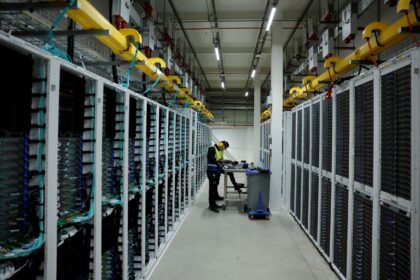
At NewsTrackerToday, the AI investment story is no longer about a single dominant winner. Nvidia remains the most visible beneficiary of the infrastructure boom, but the real dispersion of returns in 2025 has taken place deeper in the stack – across optics, memory, storage, and networking.
Nvidia has grown nearly thirteenfold since late 2022, pushing its market capitalization to roughly $4.6 trillion and cementing its role as the default proxy for AI spending. Yet over the past twelve months, investors who looked beyond GPUs often captured even stronger gains by targeting the systems that connect, feed, and scale those processors inside data centers.
This shift reflects how hyperscalers are allocating capital. With combined infrastructure spending by the four largest technology platforms projected to approach $380 billion this year, the focus is moving from raw compute acquisition toward throughput efficiency, latency reduction, and energy optimization. At NewsTrackerToday, we see this as the moment when “invisible” infrastructure becomes the profit center.
Sophie Leclerc, technology and digital infrastructure analyst, notes that AI clusters are rapidly transitioning from GPU-dense racks into fully networked systems where optical interconnects become unavoidable. This is where companies like Lumentum enter the spotlight. As AI systems scale horizontally, demand shifts from intra-rack links to rack-to-rack and eventually data-center-to-data-center optical connectivity. That dynamic has driven a sharp revaluation of Lumentum, whose revenue mix is now dominated by cloud and AI infrastructure exposure. At NewsTrackerToday, we view this as a structural tailwind – but also one that historically becomes cyclical once supply catches up with hyperscaler bargaining power.
Storage has quietly reasserted itself as another constraint. Western Digital and Seagate have both benefited from the reality that AI models do not just compute – they accumulate, retain, and retrain on massive datasets. Hard-disk drives, long dismissed as legacy technology, remain the most scalable and cost-efficient medium for this layer. Our view at NewsTrackerToday is that the market has rediscovered data gravity, though investors should remember that storage cycles turn quickly once capacity overshoots demand.
Memory sits at the most fragile pressure point. Micron has emerged as a critical supplier as high-bandwidth memory becomes indispensable for advanced AI servers. Pricing strength has followed tight allocation, but growth visibility drops sharply once new fabs come online. NewsTrackerToday sees Micron’s current momentum as justified – while also acknowledging that memory has never rewarded complacency.
The most recent re-rating has occurred at the integration layer. Celestica is benefiting from hyperscalers’ need to deploy customized, liquid-cooled, rack-scale systems at speed. As AI infrastructure becomes more bespoke, the value shifts from components to orchestration. That creates upside – and concentration risk – because design wins can be decisive.
Liam Anderson, financial markets analyst, frames the trade-off facing investors heading into 2026: AI infrastructure exposure still works, but expectations are no longer forgiving. Many of these stocks now trade as if utilization, monetization, and capex discipline will all align perfectly.
The takeaway at News Tracker Today is clear. Nvidia remains the engine of the AI buildout, but the next phase of returns will be determined by the supply chain’s ability to stay constrained rather than commoditized. If hyperscaler spending remains aggressive and infrastructure bottlenecks persist, secondary beneficiaries can continue to outperform. If not, re-pricing will be swift – not because AI demand disappears, but because valuation reached the future first.