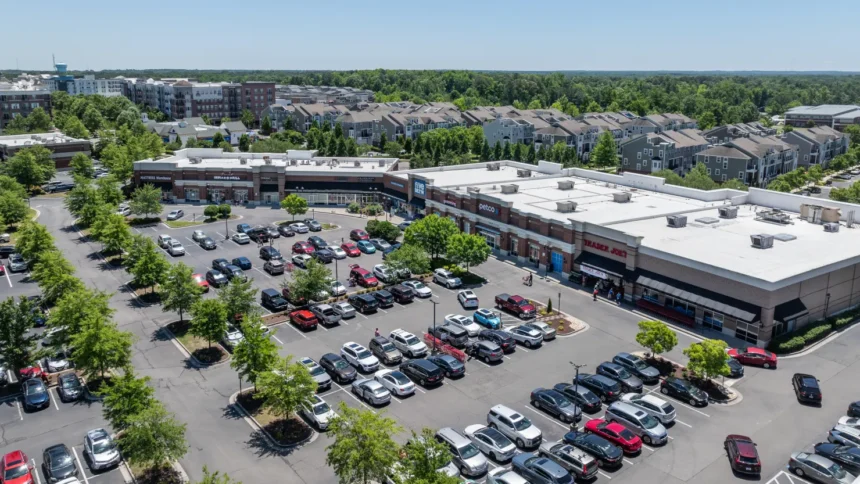
To say that the retail real estate sector has had a difficult decade would be an understatement. At NewsTrackerToday, we see it as one of the most telling barometers of structural change in the global economy: from the digital revolution in retail and the rise of e-commerce to the shocks of the pandemic and shifts in consumer behavior. And while some formats – especially large enclosed malls – are still struggling to redefine their purpose, others are quietly thriving. Among them, one category stands out: open-air shopping centers anchored by grocery stores, which have proven to be a rare combination of resilience, profitability, and liquidity.
According to Chad Phillips, Global Head of Real Estate Equity and Debt at Nuveen Real Estate, which manages over $140 billion in commercial property investments, this segment has become “the quiet beneficiary of structural disruption.” He explains: “Over the past two years, we’ve deliberately focused on open-air centers anchored by grocery and everyday-use retailers. They’re stable, they’re local, and they’ve shown remarkable consistency in performance.”
The numbers back it up. Data from CoStar Group shows that vacancy rates in grocery-anchored retail fell from 7.8% in 2016 to 4.4% at the start of 2025 – the lowest level in a decade. “These properties survived both COVID and the Amazon effect,” Phillips adds. “Over 95% of our portfolio is leased, and when a tenant leaves, there’s usually a waiting list to take their place.”
As Isabella Moretti, corporate strategy and M&A analyst at NewsTrackerToday, notes, this format has effectively become “the new safe haven for conservative capital.” She adds: “Investors are acquiring assets below replacement cost while locking in predictable income streams. In a world defined by volatility, that stability has its own premium.”
For years, the U.S. market suffered from an oversupply of retail space. The rise of e-commerce forced developers to become more disciplined, leading to a natural correction – and now, a degree of scarcity. The result: better pricing power and rising yields. According to Nuveen data, institutional allocations to retail real estate have grown from 10% to 15% in the past year. Since January, the firm has raised $1.4 billion in new capital for “essential retail” strategies – equal to roughly $2.5 billion in purchasing power with leverage.
Still, as Phillips acknowledges, the rally is beginning to slow. After five years of steady rent growth, momentum has softened for the first time in a decade. Daniel Wu, geopolitics and energy analyst, calls this a healthy recalibration: “We’re transitioning from euphoria to equilibrium. Higher rates and softer consumer sentiment are tempering short-term demand, but the fundamentals remain intact. This isn’t contraction – it’s normalization.”
CoStar data confirms that vacancy in open-air centers has risen for three consecutive quarters, though it remains near historic lows. Meanwhile, limited new construction continues to keep the balance between supply and demand tight.
At NewsTrackerToday, we believe the sector is entering a phase of rationality. The era of “everything for everyone” retail is being replaced by precision and purpose. Success now depends on strategic location and an understanding of demographic patterns. Phillips emphasizes that his firm prioritizes areas with household incomes above $100,000 and strong concentrations of educated millennials – the kind of customer base that can sustain spending even amid cyclical slowdowns.
Competition among investors is growing, but the market remains far from overheating. Transaction yields still hover in the low double digits, while low development activity keeps existing centers full and cash-flow positive.
Retail real estate has adapted. It no longer competes with digital commerce – it complements it. Grocery-anchored open-air centers have become the true face of a new realism in commercial real estate – a balance of convenience, community, and disciplined capital use.
As we often say within News Tracker Today, the market is returning to three fundamental principles: locality, liquidity, and logic. Everything else – from technology to consumer trends – merely follows their lead.