When European fintech begins to cool and industry giants tighten their grip on payments, exponential growth becomes a rarity. That is precisely why Flatpay’s rise to unicorn status in just three years feels less like a routine funding success and more like a structurally important shift. At NewsTrackerToday, we see the Flatpay case as proof that companies addressing real, everyday pain points for small businesses can outpace even the most technologically advanced competitors.
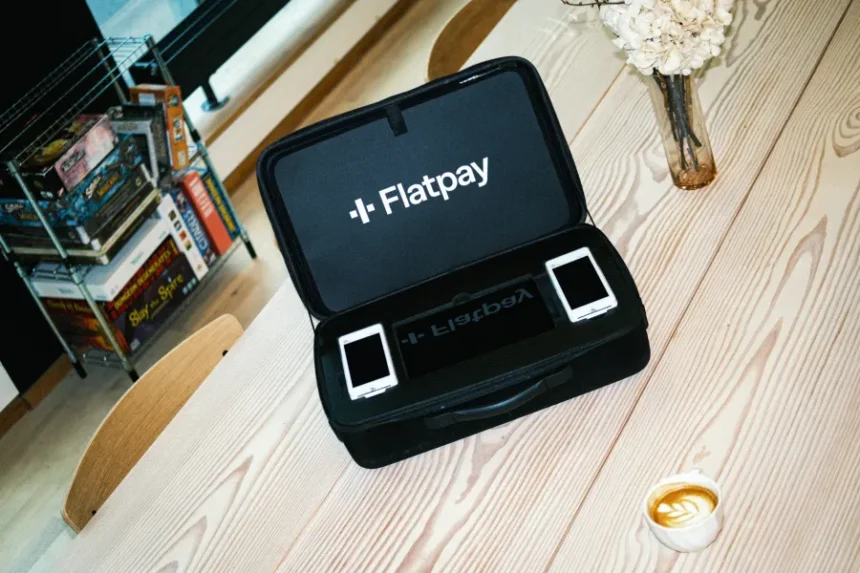
Flatpay reached a valuation of 1.5 billion euros by focusing on a segment that accounts for 99 percent of Europe’s business landscape: micro-retailers, local cafés, independent shops and single-location service providers. Instead of complex variable fees, the company offers a flat-rate model and installs its own POS terminals directly on site. From our perspective at NewsTrackerToday, this radical simplicity turned out to be a more powerful accelerator than any sophisticated digital onboarding could have been.
The client base tells the story. Flatpay scaled from roughly 7,000 merchants in April 2024 to around 60,000 today, a nearly nine-fold expansion. For Europe’s offline acquiring market, this is an extraordinary pace. Liam Anderson, our financial markets expert, notes: “Growth like this typically signals either a price war or a product that solves an ignored problem. With Flatpay, it’s clearly the latter.” His observation mirrors the company’s financial trajectory: annual recurring revenue surpassed 100 million euros in October and is, according to the CEO, increasing by nearly 1 million euros per day.
But the ambition goes further. CEO and co-founder Sander Janka-Jensen aims for 300 percent growth by 2026, targeting 400 to 500 million euros in ARR. To support this acceleration, the company raised 145 million euros in its latest funding round from AVP, Smash Capital and Dawn Capital. Notably, earlier investors included private figures such as footballer Mario Götze – a sign of how the brand resonates even outside tech circles.
What makes Flatpay distinct, however, is that its growth model is deeply physical rather than digital. The company employs roughly 1,500 people, planning to double that number by next year. These teams spend their days visiting shops, demonstrating terminals and closing deals face-to-face. It is an approach that builds trust – but also drives acquisition costs well above the fintech norm. At NewsTrackerToday we note that this model challenges conventional industry assumptions. As Isabella Moretti, our corporate strategy and M&A analyst, explains: “Flatpay is following a path traditionally viewed as too expensive. Yet in the SMB sector, human contact isn’t a luxury, it’s a competitive edge. The real question is whether that edge can scale without breaking the economics.”
Flatpay now operates in Denmark, Finland, Germany, Italy, France and the UK. Judging by job listings, the Netherlands may be next – a move that would place the startup directly in Adyen’s domestic arena. For investors, this expansion phase is pivotal: Flatpay will either consolidate its status as Europe’s next-generation SMB acquirer or encounter the limits of its high-touch model in markets where competitors have deep infrastructure and banking partnerships.
At the same time, the company is expanding its vision beyond payments. Flatpay is experimenting with voice-based AI support, real-time machine-learning monitoring and preparing to introduce a banking toolkit with cards and business accounts. Still, the firm maintains a cautious philosophy of incremental rollout, allowing merchants to “digest the elephant one piece at a time,” as Janka-Jensen puts it. This protects the core promise of simplicity – the very element that brought Flatpay its initial success.
In conclusion, we at News Tracker Today believe Flatpay’s rise is built not on cutting-edge technological novelty but on the ability to deliver what small merchants have been denied for years: transparent pricing, hands-on service and instant readiness. Yet to justify its 1.5-billion-euro valuation and achieve its declared ten-fold growth by 2029, the company must prove that its human-centric model can scale without eroding margins. Our outlook: if Flatpay manages to balance expansion with discipline, it could become Europe’s defining SMB payments player of the decade. If not, the road from unicorn to ubiquity may turn out steeper than it appears today.