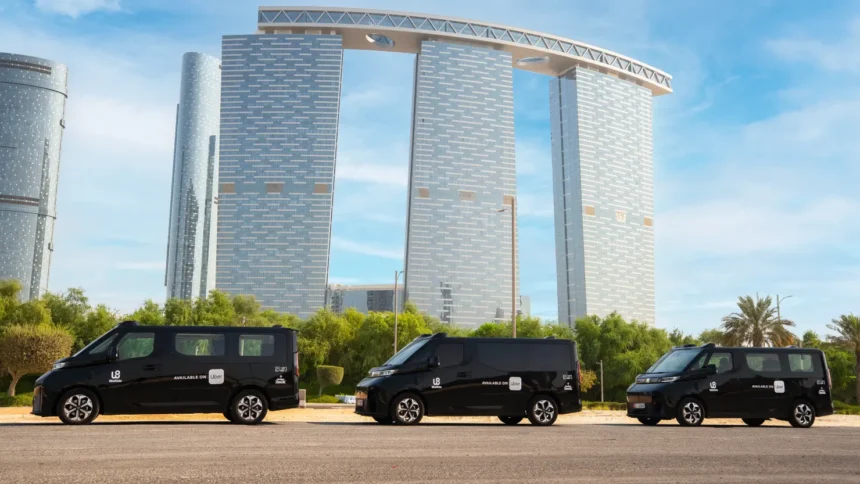
Uber has spent years trying to convince the market that autonomous mobility is not a distant experiment but an inevitable shift in how cities function. Its latest move – launching fully driverless rides in Abu Dhabi in partnership with China’s WeRide – marks the moment this vision steps onto the global stage. For the first time in the Middle East, Uber riders can summon a robotaxi with no operator inside, turning Yas Island into a living testbed for what the next decade of urban transport may look like, a transition closely followed by NewsTrackerToday.
The rollout is more than a technical milestone. It reflects Uber’s broader strategy: the company no longer aims to build its own autonomous system but instead to assemble a global network of technology partners. Riders can request a WeRide robotaxi through UberX or Uber Comfort, and choosing the autonomous option increases their chances of getting a driverless vehicle. Operational responsibilities are split – local partners manage the fleet, while WeRide provides the AV technology – allowing Uber to focus on scaling the platform rather than engineering the hardware. As we at NewsTrackerToday observe, this shift transforms Uber from a transportation company into an orchestrator of autonomous ecosystems across continents.
This is not an isolated launch. In the United States, Uber already integrates Waymo robotaxis in Phoenix, Austin and Atlanta. The company’s partnership with Lucid and Nuro aims to deploy thousands of autonomous EVs based on the Lucid Gravity platform over the next six years. Taken together, these alliances reveal a deliberate pattern. According to geopolitical and technology analyst Daniel Wu, “Uber is intentionally diversifying its autonomous portfolio across regions and suppliers. It reduces geopolitical exposure, regulatory risk and technological dependence – the very vulnerabilities that slowed earlier attempts at in-house AV development.”
For WeRide, Abu Dhabi is a proving ground beyond China. The company already operates fully driverless robotaxis in Beijing and Guangzhou and is positioning itself as a serious competitor to the American AV ecosystem. The UAE, meanwhile, is using the partnership to reinforce its identity as an early adopter of frontier technology. Its regulatory environment enabled WeRide to operate without a safety driver – something many Western cities still limit – giving Uber the perfect platform to observe real passenger behavior in a controlled but publicly accessible environment.
Competition is heating up elsewhere. Lyft is preparing to launch Waymo-powered robotaxis in Nashville next year, signaling that the North American market is shifting from human drivers to multi-provider autonomous fleets. But Uber currently holds the broader geographic lead, operating across four autonomous markets and planning expansion into more than a dozen additional cities.
The economic model, however, remains opaque. Uber does not disclose revenue-sharing terms with its AV partners, and profitability will depend heavily on utilization rates and operational efficiency. NewsTrackerToday technology-sector analyst Sophie Leclerc argues that “autonomous mobility will only become a sustainable line of business once unit economics depend on scale and load factor rather than subsidized experimentation.” She notes that Uber’s partnership-driven approach significantly lowers capital intensity and allows the company to expand faster than rivals trying to develop AV technology internally.
Abu Dhabi’s deployment offers something closer to a controlled societal experiment than a tech demo. If the system scales seamlessly beyond Yas Island into more complex urban environments, it will provide the strongest case yet that autonomous mobility is ready for real-world city dynamics. If challenges surface – whether regulatory, operational or cultural – they will shape how quickly Uber can export the model to Europe, Asia and beyond.
From the vantage point of News Tracker Today, this launch marks a strategic turning point. It signals Uber’s transition from a ride-hailing operator to a global integrator of autonomous technologies – a company that sells consistency and reach rather than metal and software. Success will depend on load optimization, rider trust and continued regulatory cooperation. Failure would mean another stalled chapter in the long and uneven journey toward commercial autonomy.
But if Uber succeeds, the option labeled “Autonomous” in the app could soon become the default, while the traditional human-driven ride quietly shifts from the norm to the exception.