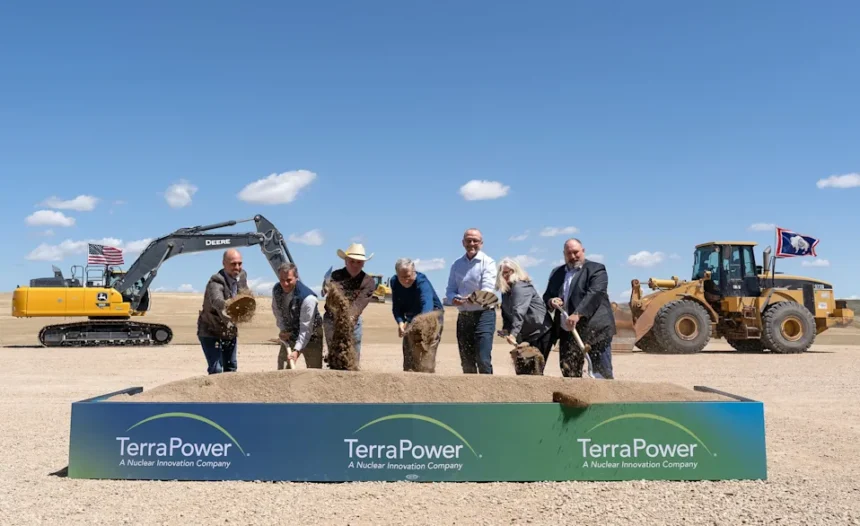
The approval granted this week by the U.S. Nuclear Regulatory Commission (NRC) to TerraPower marks one of the most significant regulatory milestones for advanced nuclear technology in recent years. The decision allows the company to begin construction of its Natrium reactor near a retiring coal plant in Wyoming, signaling renewed momentum for next-generation nuclear energy in the United States. NewsTrackerToday notes that the permit comes as governments and investors increasingly focus on expanding reliable electricity generation to meet rising demand from artificial intelligence infrastructure and data centers.
TerraPower, founded by Bill Gates and backed by major technology investors, is developing the Natrium reactor in partnership with GE Vernova Hitachi. The planned plant will generate about 345 megawatts of electricity – smaller than traditional nuclear reactors but significantly larger than many small modular reactor concepts pursued by other startups. According to Daniel Wu, a geopolitical and energy analyst, the project reflects a broader shift in energy policy as advanced nuclear becomes linked not only to climate goals but also to energy security and industrial competitiveness.
A key feature of the Natrium design is its use of liquid sodium as a coolant instead of water, which has been the dominant approach in most reactors built over the past fifty years. The system also includes a large thermal storage component that stores excess heat in molten sodium and releases it during periods of higher electricity demand. NewsTrackerToday highlights that this flexibility could make nuclear energy more compatible with renewable power systems by helping stabilize grids increasingly reliant on wind and solar generation.
The approval is also notable because TerraPower followed the traditional NRC licensing process, allowing construction on privately owned land rather than federal facilities. According to Liam Anderson, a financial markets specialist at NewsTrackerToday, successfully obtaining a permit through the standard regulatory pathway strengthens investor confidence in the broader advanced nuclear sector.
Investor interest in nuclear startups has grown rapidly in recent years. Venture capital and strategic investors have committed more than $1 billion to nuclear energy startups as electricity demand rises alongside the expansion of AI computing infrastructure. TerraPower itself has raised roughly $1.7 billion, including a major investment round completed in 2025.
Despite this momentum, nuclear power still faces serious economic challenges. Historically high construction costs and long development timelines have made nuclear one of the most expensive sources of new electricity generation. At the same time, solar, wind and battery technologies have reduced costs dramatically, intensifying competition for new power projects.
Many advanced nuclear developers believe modular construction and large-scale manufacturing could eventually lower costs. However, these advantages remain largely unproven in commercial deployment and may take years to demonstrate. News Tracker Today suggests the Natrium project will serve as a critical test case for whether advanced reactor designs can transition from promising technology concepts to commercially viable energy infrastructure. If successful, the model could help replace aging coal plants while providing reliable low-carbon power for future industries.