Uber, Lucid Motors and Nuro used CES 2026 to signal a shift in the robotaxi race – from experimentation to early industrialisation. From the perspective of NewsTrackerToday, the debut of their production-ready robotaxi is less about spectacle and more about proving that autonomous mobility can finally move toward repeatable manufacturing and a defined commercial rollout.
The vehicle, built on the Lucid Gravity SUV platform, is the product of a partnership that has been in development for more than six months. As part of the broader deal, Uber committed $300 million to Lucid and agreed to purchase up to 20,000 vehicles. The companies confirmed that the robotaxi is already being tested on public roads, with a commercial service targeted for the San Francisco Bay Area by the end of the year. NewsTrackerToday views this as a notable escalation: timelines are now measured in months, not abstract “future readiness.”
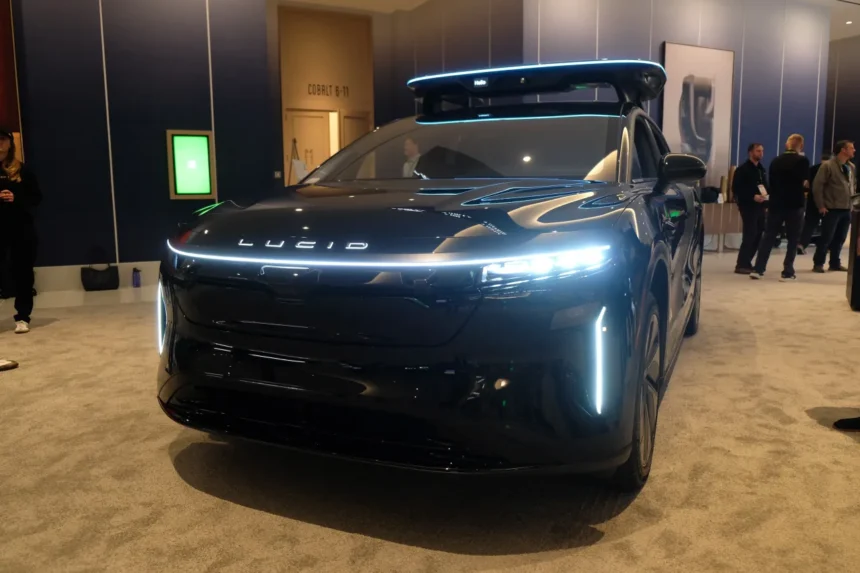
Technically, the robotaxi reflects a premium-first strategy. The Gravity-based platform integrates high-resolution cameras, solid-state lidar and radar sensors, all housed within the body and a roof-mounted halo. Computing is handled by Nvidia’s Drive AGX Thor system, while external LED lighting is designed to help passengers identify the vehicle – an approach similar to what riders have seen in existing Waymo fleets. According to Sophie Leclerc, technology sector analyst at NewsTrackerToday, the hardware choices suggest a deliberate trade-off. “This is not a cost-minimised robotaxi,” she notes. “It’s designed to prioritise redundancy, sensor richness and passenger confidence, even if that raises the upfront cost per vehicle.”
One of the most strategically important elements is manufacturing integration. Unlike competitors that retrofit autonomy systems after vehicles leave the factory, Lucid is installing much of the autonomous hardware during assembly at its Arizona plant. From NewsTrackerToday’s standpoint, this could prove decisive. Factory-level integration reduces labor intensity, shortens deployment cycles and lowers long-term maintenance complexity – factors that often determine whether pilot programs can scale.
User experience is also being treated as a core component rather than an afterthought. The in-cabin interface mirrors patterns already familiar to riders of existing autonomous services, including a rear passenger display showing an isometric view of the surrounding environment, estimated arrival times and nearby traffic participants. Controls for climate, media, support contact and an emergency stop are integrated directly into the interface. While the interactive software stack is still being finalised, the emphasis on transparency reflects an industry-wide lesson: trust is built visually and incrementally, not through autonomy claims alone.
Still, risks remain. Lucid’s first year of Gravity production was marked by software challenges significant enough to prompt a public apology from management. Whether those issues reappear in a robotaxi context is an open question. Isabella Moretti, who covers corporate strategy for NewsTrackerToday, highlights this as a critical variable. “In consumer vehicles, software issues damage brand perception,” she says. “In a robotaxi fleet, they directly impact uptime, unit economics and regulatory confidence.”
Looking ahead, News Tracker Today expects the Uber–Lucid–Nuro partnership to be judged less on technical ambition and more on operational discipline. Premium hardware and factory integration offer a credible path to scale, but only if reliability and service consistency follow. If the Bay Area rollout proceeds without prolonged delays or safety setbacks, the project could redefine expectations for commercially viable robotaxi services. If not, it risks joining a long list of autonomous initiatives stalled between prototype and profit.
The larger implication is becoming harder to ignore. The CES 2026 unveiling marks a turning point where autonomous mobility is no longer framed as a distant promise, but as a near-term operational challenge. For NewsTrackerToday, the coming year will reveal whether this collaboration can convert industrial design and capital commitments into a sustainable robotaxi business – or whether autonomy’s hardest problems still lie beyond the show floor.