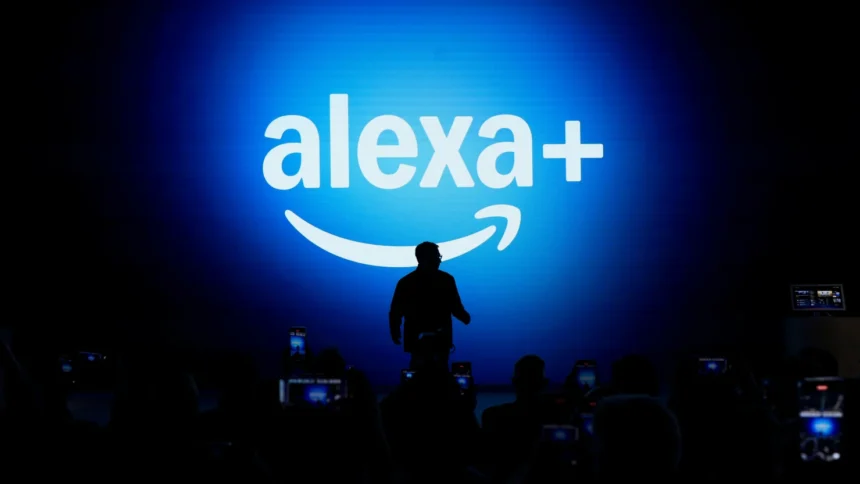
Amazon has taken a meaningful step to reposition Alexa for the generative-AI era by launching Alexa.com, a browser-based interface that allows users to interact with its upgraded AI assistant, Alexa+. From the perspective of NewsTrackerToday, this move is less about adding another access point and more about redefining Alexa from a voice-first household tool into a multi-interface AI platform.
Until now, Alexa+ was largely confined to mobile apps and select Echo devices. The introduction of a web interface places Amazon in more direct competition with browser-native AI assistants such as OpenAI’s ChatGPT and similar offerings from Google and others. Strategically, Amazon is acknowledging a clear behavioral shift: many of the most valuable AI use cases – research, writing, planning and synthesis – now happen on laptops rather than through voice commands.
Amazon says users can rely on Alexa.com to get quick answers, explore complex topics, generate content, plan trips and manage homework, while also controlling smart-home devices through a chat interface. According to Sophie Leclerc, technology sector analyst at NewsTrackerToday, this dual focus is essential for Amazon’s positioning. “Alexa’s historical strength has always been execution – turning intent into action,” she notes. “The browser interface is Amazon’s attempt to close the gap with conversational AI leaders while preserving its advantage in real-world task completion.”
Access remains limited. Alexa.com is currently available only to Alexa+ users in early access, with onboarding handled through a waitlist or newer compatible devices. From NewsTrackerToday’s analysis, this controlled rollout suggests Amazon is prioritizing reliability over speed. Rather than risking a high-visibility misstep, the company appears focused on refining accuracy, latency and consistency across voice, mobile and web environments. The move also reflects mounting pressure on Amazon following the rapid rise of consumer-facing AI chatbots. While Alexa achieved massive household penetration, it struggled to evolve into a durable revenue engine. Alexa+ represents a renewed effort to reposition the assistant as context-aware, proactive and commercially relevant, rather than a passive command-and-response layer tied primarily to hardware.
From a competitive standpoint, the browser launch narrows a key structural gap. AI assistants from Google, Anthropic and Perplexity have benefited from being embedded directly into users’ daily work environments. By entering the browser, Amazon reduces friction and increases the probability that Alexa becomes part of routine workflows instead of an occasional voice interaction. Ethan Cole, chief economic analyst at NewsTrackerToday, argues that this shift has broader implications. “The real competition is no longer about novelty or model size,” he says. “It’s about who captures recurring utility in everyday decision-making, where browsers remain the primary interface.”
The business implications are significant. Alexa+ is positioned as a premium service, often bundled with Prime, giving Amazon a distribution advantage that most AI competitors lack. However, News Tracker Today notes that bundling alone will not guarantee engagement. Users will benchmark Alexa+ directly against established AI tools on reasoning depth, speed and, most critically, reliable task execution.
Looking ahead, the success of Alexa.com will depend on whether Amazon can deliver a genuinely seamless experience across voice, mobile and web. If Alexa+ can move fluidly from planning in the browser to executing actions across connected devices, Amazon secures a defensible niche in consumer AI. If not, the web interface risks becoming just another hatbot in an already saturated market.
The broader takeaway is clear. Amazon is no longer treating generative AI as an accessory to hardware. With Alexa.com, it is signaling an ambition to compete for time, attention and utility in the browser – where the next phase of consumer AI adoption will be decided. For NewsTrackerToday, this marks one of Amazon’s most consequential AI product shifts in years, with 2026 likely to determine whether Alexa evolves into a true platform or remains anchored to its original voice-driven identity.