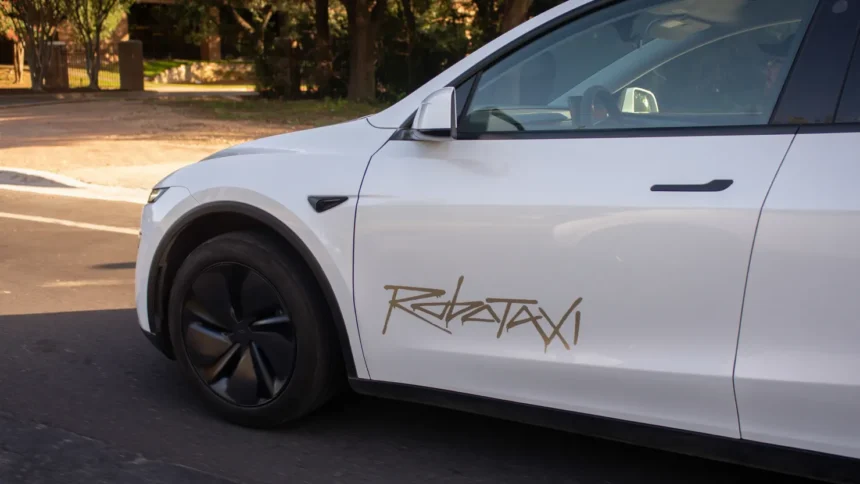
Tesla’s long-running ambition to redefine autonomous mobility took another step forward this week, as the company secured approval to operate ride-hailing services in Arizona. The permit, granted by the Arizona Department of Transportation, does not yet authorize full driverless operations, but it formally recognizes Tesla as a transport network provider in one of the most competitive markets for robotaxi development. At NewsTrackerToday, we view this regulatory shift as one of those subtle yet decisive inflection points that often precede major industry transitions.
The newly granted license allows Tesla to function as a ride-hailing operator, but a separate authorization will be required before the company can deploy fully autonomous vehicles on public roads. This nuance matters: Tesla has entered the regulatory framework, but not yet crossed the technological threshold. Still, the approval positions the company inside the transport ecosystem of a state that has become a frontline arena for autonomous mobility.
Arizona’s decision follows several months of intensified testing by Tesla. In Phoenix, the company filed applications to run autonomous vehicles with human safety drivers, while in Austin it launched a pilot program involving remote operators and parking attendants. Tesla says it aims to remove human supervision entirely in Austin by year-end. According to Sophie Leclerc, technology analyst at NewsTrackerToday, “The pace Tesla is signaling reflects competitive pressure rather than technological certainty. The market no longer rewards futuristic vision alone; it demands proof in real-world performance.”
That pressure is visible when Tesla’s progress is compared with the industry’s more established players. In the Phoenix metro area, Waymo operates a commercial fleet of at least 400 fully driverless vehicles and recently surpassed 10 million autonomous rides across the United States. In China, Baidu’s Apollo Go recorded 3.1 million fully driverless trips in the third quarter alone, up 212 percent from the previous year. Against that backdrop, Tesla is entering a field where commercial standards are being defined by companies with significantly more operational mileage.
Safety data adds another layer of complexity. The National Highway Traffic Safety Administration has documented seven reported collisions involving Tesla vehicles using autonomous functions as part of the Texas pilot. While not catastrophic, the numbers highlight the technology’s remaining limitations. Ethan Cole, chief macroeconomic analyst at NewsTrackerToday, notes that “Investor confidence in emerging technologies rests not on promises of tomorrow but on execution today. Safety reliability is the real currency in this space.”
Even so, Elon Musk continues to shape the emotional narrative around autonomy. At Tesla’s 2025 shareholder meeting earlier this month, he claimed the “killer app” for self-driving technology would be the ability to text or sleep while the car handles everything. He insisted Tesla is “on the cusp” of full autonomy, acknowledging that he has said similar things before. The gap between ambition and validated performance remains the central tension for the company.
For now, the new Arizona permit creates a pathway toward Tesla’s stated plan to launch commercial robotaxi services in Phoenix and other US cities by 2026. But the company must still prove it can meet regulatory standards, scale safely and withstand intensifying competition in a sector that requires massive capital, disciplined execution and sustained public trust.
At News Tracker Today, we see three critical questions shaping Tesla’s trajectory. First, can the company deliver safety metrics that match or exceed sector leaders. Second, can Tesla scale operational capacity faster than Waymo and Baidu consolidate their dominance. And third, can Tesla maintain financial resilience while investing heavily in autonomous infrastructure.
For investors, the takeaway is clear: focus less on rhetoric and more on regulatory progress, testing data, incident statistics and regional approvals. The period between 2025 and 2026 will determine whether Tesla becomes a top-tier global robotaxi operator or remains an ambitious challenger in one of the most capital-intensive technological races of the decade.