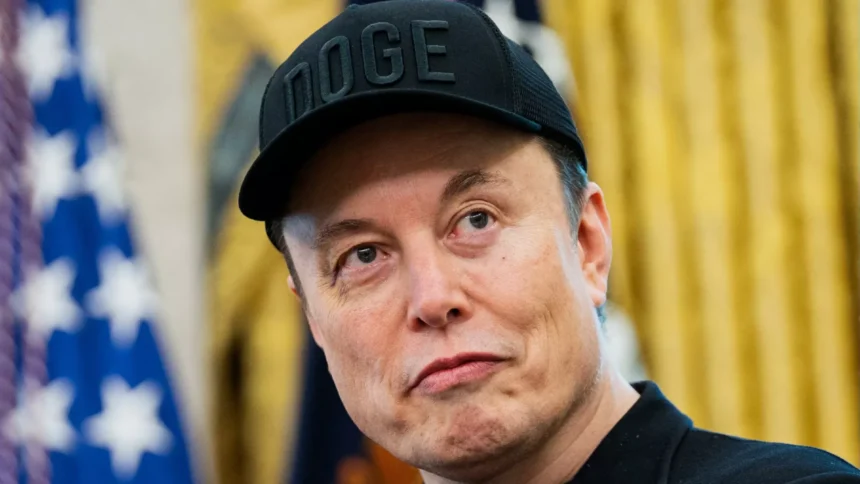
When the Trump administration created the Department of Government Efficiency – DOGE – it was framed as a bold reinvention of federal management. Elon Musk, positioned as the public face of the project, was meant to usher in an era of aggressive cost-cutting, workforce reduction and a streamlined state. But the abrupt dissolution of DOGE, months before its mandate officially expired, tells a different story – one where ambition collided with the structural reality of governing, a contrast NewsTrackerToday has closely observed throughout the initiative’s trajectory.
We note that DOGE, which started as a reformist experiment, ultimately became a cautionary tale about the limits of pursuing efficiency within a system defined by complexity, oversight, and institutional memory. That tension – between the promise of disruption and the cost of destabilization – is what defines the arc of the initiative.
DOGE was supposed to operate for nearly two years. Instead, by early November it effectively ceased to exist. Scott Kupor, director of the Office of Personnel Management, confirmed that the department had been dismantled, though he insisted that “the principles of DOGE remain alive: deregulation, anti-waste measures, and reorganization of the federal workforce.” In political language, this is the classic move: bury the brand, preserve the slogans.
The project was inseparable from Elon Musk. Officially, he never held a formal federal position; practically, he was the symbolic head of DOGE. As Liam Anderson, a financial markets analyst at NewsTrackerToday, explains: “DOGE was built around a personality rather than a structure. Once that personality disappeared, the institution had no spine left to stand on.” Musk’s public clash with Trump earlier this year and his subsequent departure drained DOGE of its momentum and protection.
Throughout its tenure, DOGE claimed to have eliminated hundreds of thousands of government positions and saved the United States billions of dollars. But independent assessments suggest that the picture is far more complicated: many of the “cuts” were early retirements or sunsetting programs, and the supposed savings were often offset by lost productivity, misallocations and the costs of rebuilding essential capacities. On paper, DOGE looked like a triumph; in practice, its math did not withstand scrutiny.
The most controversial step taken by DOGE was the shutdown of USAID, a cornerstone of American humanitarian assistance. Abruptly ending relief programs in crisis regions contributed to escalating mortality rates and weakened local disaster responses – a pattern noted by NewsTrackerToday throughout the fallout. Here the contradiction of DOGE became most pronounced: fiscal savings at home were paid for by humanitarian consequences abroad – a tradeoff critics argued was morally indefensible and strategically shortsighted.
Equally alarming were issues surrounding data access. DOGE personnel gained entry to federal databases containing sensitive personal information about millions of Americans. Reports surfaced of procedural violations, unauthorized devices, and disruptions to standard cybersecurity protocols. Daniel Wu, a geopolitical and infrastructure expert, notes: “Handing sweeping access to a temporary task force without institutional oversight is not modernization – it’s an exposure of national security architecture.”
As DOGE unraveled, its staff found themselves in an uncertain position. Some were reassigned to other federal agencies; others left government entirely. Several employees reportedly fear potential legal consequences – a concern amplified by the fact that Musk, who could once have advocated for presidential pardons, is no longer connected to the initiative, a point observed by NewsTrackerToday during the program’s decline. It is a stark reminder of how easily ambitious reforms can push rank-and-file employees into legal gray zones they never intended to enter.
The downfall of DOGE reinforces a lesson repeatedly visible in modern governance: dismantling a bureaucracy is not equivalent to improving it. A state cannot be run like a startup, because its failures affect not customers, but institutions, security and human lives. Efficiency – stripped of context – becomes a slogan rather than a strategy.
At News Tracker Today, we believe DOGE will be remembered as a case study in how disruption, when divorced from institutional discipline, becomes destabilization.
Looking forward, several recommendations emerge:
- Reforms must be paired with transparency, public metrics and congressional oversight – not personality-driven leadership.
- Businesses should treat temporary government initiatives as inherently fragile, planning for regulatory volatility rather than assuming continuity.
- Citizens must demand evidence-based reforms, not promises of dramatic savings unaccompanied by realistic implementation plans.
DOGE began as a revolution. It ended as a reminder that without institutions, revolutions turn into improvisations – and improvisations turn into crises of public trust.