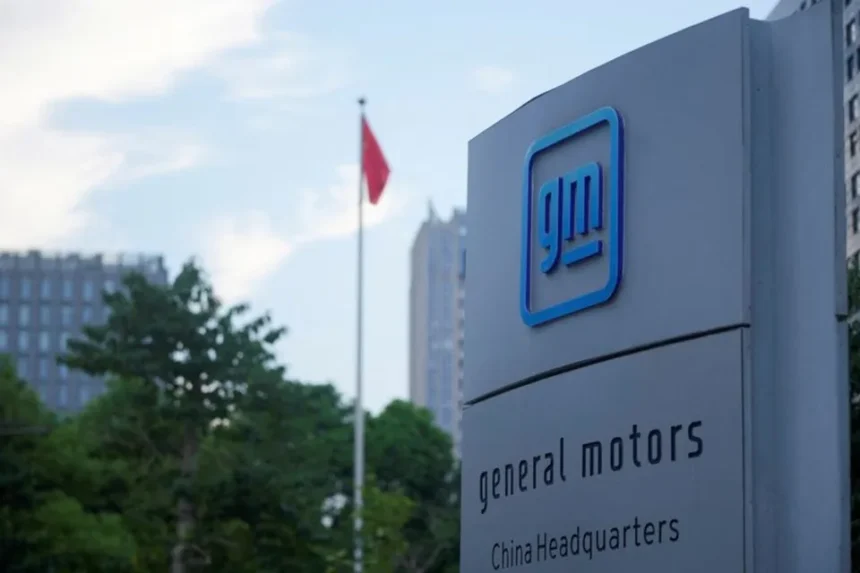
General Motors said Tuesday it has renewed its joint-venture agreement with China’s SAIC Motor for 20 years, following a lengthy restructuring that included plant closures and the elimination of some models. As part of the extended 50-50 partnership, GM will discontinue Chevrolet sales in China entirely, focusing instead on its Cadillac and Buick brands. A company doubling down on a 20-year China commitment while simultaneously retreating from one of its own core brands in that exact market is what NewsTrackerToday sizes to as the more complicated signal than the renewal itself.
The scale of GM’s China decline explains why this restructuring became necessary in the first place: the company sold 1.9 million vehicles in China last year, down 51% from 2016, as increasingly sophisticated domestic automakers and a sharp market shift toward electric vehicles eroded the position GM built after becoming one of the first global automakers to enter China through its original 1997 SAIC partnership.
Daniel Wu, who covers geopolitics and energy, reads the export provisions built into this renewed agreement as its most consequential detail: “The new terms let GM use China as an export hub, shipping Buicks and Cadillacs to the Middle East, Africa, South America, Mexico, and other parts of Asia. That’s GM explicitly leveraging Chinese manufacturing cost advantages and EV supply-chain maturity to serve markets outside China entirely, a meaningfully different strategy than simply trying to win back domestic Chinese market share the company has been steadily losing for a decade.” That export-hub strategy, more than the joint-venture renewal itself, is what NewsTrackerToday draws to as the real substance behind this 20-year commitment.
Notably absent from those export plans is the United States: the joint venture has no plans to export to the American market, since tariffs and national-security policies targeting China-developed technology have kept Chinese-built vehicles out of the U.S. regardless of which global automaker’s badge they carry.
Isabella Moretti reads the financial turnaround underneath this renewal as evidence the restructuring already delivered real results: “GM recorded more than $5 billion in non-cash charges against its China joint venture when this restructuring began in 2024, after years of watching profits that once ran around $2 billion annually evaporate into losses. Since then, GM has posted several consecutive quarters of profit, most recently $83 million in the second quarter. That’s a real turnaround, small in absolute terms next to what GM once earned in China, but a genuine reversal from the losses that made this restructuring urgent in the first place.” That reversal from loss to modest profit, more than the 20-year term itself, is what NewsTrackerToday reads to as the more meaningful validation behind GM’s decision to recommit rather than exit.
The joint venture’s new Buick Electra sub-brand, developed entirely in China, already shows signs of working: its first model, the Electra E7 SUV, sold more than 10,000 units in its first month on the market and will become the joint venture’s first premium model sold overseas, with international sales starting in October.
None of this confirms whether GM’s narrower brand focus and export-hub strategy actually restores the market position it once held in China, since domestic competitors have continued gaining sophistication and market share even as GM’s own restructuring has stabilized its finances. Whether the Electra sub-brand and broader export strategy prove durable enough to justify a full 20-year commitment, or whether GM finds itself renegotiating this partnership’s terms again well before that term expires, is what News Tracker Today settles round as the real question this renewal leaves for the years ahead.