As pressure mounts across the fast-casual restaurant sector, major chains are increasingly turning to automation not as a novelty, but as a defensive operating strategy. From the perspective of NewsTrackerToday, investments by Chipotle and Cava into automated makeline technology from Hyphen reflect a broader recalibration: speed, consistency and labour efficiency are becoming existential variables rather than incremental improvements.
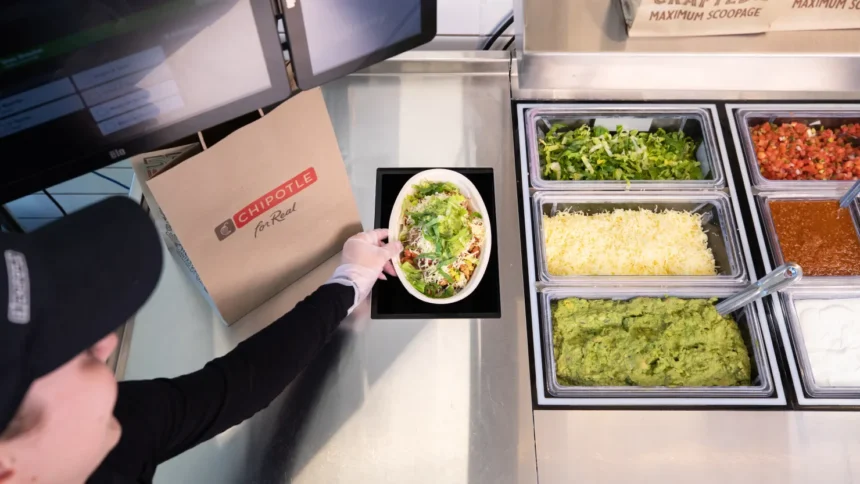
Hyphen, based in San Jose, is positioning its automated conveyor systems as a solution to two chronic pain points in modern restaurant operations – peak-hour congestion and workforce strain. The system moves much of the repetitive assembly process below the counter, where robotic components portion and assemble bowls and salads out of sight, allowing frontline staff to focus on finishing, quality control and guest interaction. According to Hyphen’s leadership, the technology can deliver a completed portion every 10 to 15 seconds, providing surplus capacity precisely when lunch and dinner demand spikes.
From an analytical standpoint, the critical value is not headline speed but elasticity. Sophie Leclerc, technology sector columnist at NewsTrackerToday, notes that fast-casual brands rarely fail on average throughput; they fail during narrow peak windows. When queues lengthen or order accuracy slips in those moments, customer churn accelerates and recovery costs rise sharply. Automation that absorbs peak stress without altering the guest experience therefore carries disproportionate strategic value.
Investor interest underscores that logic. Hyphen closed a $25 million Series B round in August 2025, with Cava committing up to $10 million and Chipotle investing a cumulative $25 million through its Cultivate Next venture arm by the third quarter of the year. The funding is earmarked for scaling production and expanding deployments across the U.S., supported by manufacturing partner Re:Build Manufacturing. From NewsTrackerToday’s viewpoint, the choice of a domestic manufacturing partner signals a focus on reliability and serviceability – often the hidden failure points of restaurant automation.
The economics appear compelling on paper. Hyphen estimates system costs between $50,000 and $100,000 per line, with many restaurant clients reportedly recouping the investment in under a year. Crucially, the return is driven less by headcount reduction than by lower error rates, reduced food waste and faster onboarding of new staff. The system tracks ingredients down to the gram, tightening portion control and dampening cost volatility during periods of inflation.
That said, automation introduces its own balancing act. Isabella Moretti, analyst covering corporate strategy and M&A at NewsTrackerToday, cautions that precision must not erode perceived value. While tighter portioning improves margins, overly aggressive optimisation risks alienating customers accustomed to generous servings. Successful operators will treat automation as a calibration tool, not a blunt cost-cutting instrument.
The broader market context reinforces the urgency. Publicly traded fast-casual brands have faced sharp equity drawdowns in 2025 amid softer demand from younger consumers and rising operating costs. Sweetgreen, for example, recently divested its robotics unit Spyce to Wonder for $186.4 million, opting to access automation via partnership rather than ownership. To News Tracker Today, this move signals sector maturation: automation is no longer experimental, but it does not need to sit on every balance sheet.
Looking ahead, Hyphen’s focus on highly customised, high-volume concepts – rather than traditional fast food – appears deliberate. These are precisely the formats where digital ordering dominates and kitchen complexity outpaces human throughput. The company is also expanding its software ambitions, aiming to layer planning and operational analytics atop its hardware.
The conclusion is pragmatic rather than futuristic. Automation will not rescue weak brands or collapsing demand. However, as NewsTrackerToday concludes, for operators facing margin pressure and volatile traffic patterns, systems like Hyphen’s offer something increasingly rare in the sector: operational predictability. In 2026, competitive advantage in fast-casual dining may hinge less on menu innovation and more on who can deliver the same bowl, at the same speed, every time – especially when the line is longest.