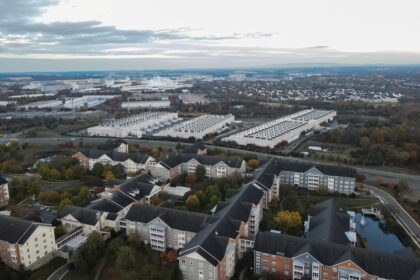
Microsoft is attempting to reset the narrative around AI-driven data center expansion as public resistance intensifies across multiple U.S. states. By publicly pledging that nearby communities will not face higher electricity prices – and that the company will fully absorb the infrastructure costs required to support new facilities – Microsoft is signaling a shift from quiet negotiations to overt political and economic reassurance. NewsTrackerToday views this move as an effort to neutralize one of the most effective pressure points facing hyperscalers: local utility backlash.
At the center of the announcement is Microsoft’s commitment to pre-arranged agreements with utility providers, allowing grid upgrades to be funded directly by the company rather than spread across residential ratepayers. From an economic standpoint, this reframes the data center debate from abstract “growth versus cost” arguments into a clearer allocation-of-burden model. Ethan Cole, chief macroeconomic analyst at NewsTrackerToday, notes that as AI infrastructure scales, regulators are increasingly focused not on total investment levels, but on who ultimately internalizes risk and cost. In his assessment, Microsoft is attempting to preempt regulatory intervention by voluntarily assuming financial responsibility before mandates are imposed.
Electricity, however, is only part of the equation. Water usage has become an equally sensitive issue in regions hosting large-scale data centers. Microsoft’s pledge to replenish more water than its facilities consume reflects a broader industry trend toward resource-offset frameworks. NewsTrackerToday emphasizes that such commitments are now judged locally, not globally. Communities want proof that replenishment benefits the same watersheds under stress, not distant offset projects that satisfy accounting goals but fail to ease regional scarcity.
Another notable aspect of Microsoft’s approach is its explicit rejection of property tax abatements as an incentive tool. Instead, the company is positioning data centers as long-term contributors to municipal tax bases. Sophie Leclerc, technology sector analyst, observes that this messaging is designed to counter a growing perception gap: data centers generate significant infrastructure strain but comparatively limited employment. By focusing on tax revenue rather than jobs, Microsoft is attempting to realign expectations before opposition hardens into zoning resistance or ballot-driven restrictions.
Recent history explains the urgency. Microsoft has already withdrawn from at least one proposed site following sustained local opposition, illustrating that permitting risk has become a material constraint on AI expansion. Across the industry, grid interconnection delays, water access disputes, and political scrutiny are extending timelines and increasing costs. NewsTrackerToday interprets Microsoft’s public commitments as a bid to preserve execution speed in an environment where capital is abundant but approvals are not.
Looking ahead, the likely outcome is not reduced scrutiny but more formalized conditions. Communities and regulators are expected to demand binding agreements on utility rates, water accounting, emergency services and infrastructure upgrades before granting approvals. For Microsoft, absorbing these costs may prove cheaper than prolonged delays or canceled projects. For the broader sector, the message is clear: scale alone no longer guarantees access.
In the assessment of News Tracker Today, the AI infrastructure race is entering a phase where social acceptance and fiscal transparency matter as much as engineering capacity. Companies that can demonstrate credible cost containment for host communities will maintain momentum. Those that cannot risk finding their expansion plans stalled – not by technology limits, but by local resistance.