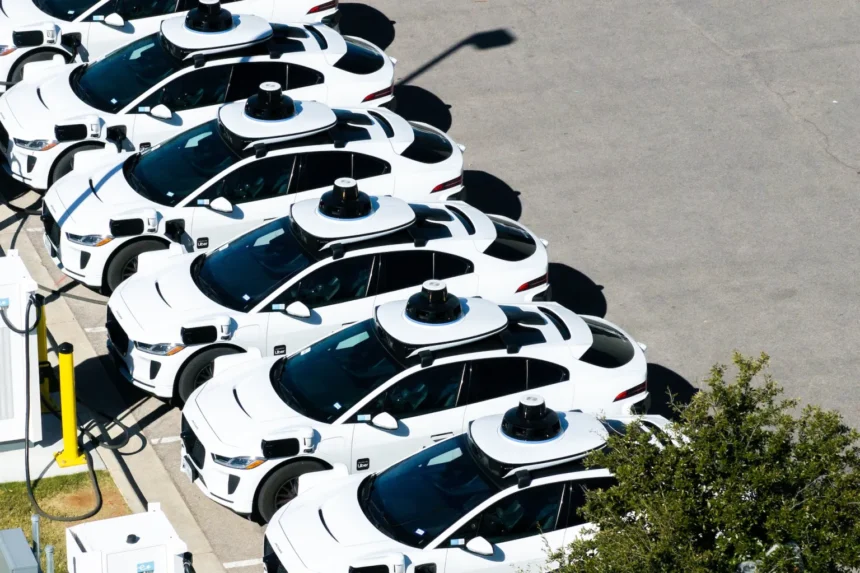
Waymo has taken a decisive step toward global scale, securing $16 billion in fresh funding as it accelerates the rollout of autonomous taxi services across more than a dozen new cities worldwide. The financing round, which values the Alphabet-owned company at roughly $126 billion, reflects growing investor confidence that robotaxis are shifting from experimental deployments into a capital-intensive transportation business, according to NewsTrackerToday’s assessment of the funding landscape.
The size of the raise places Waymo among the most highly valued private technology companies globally and signals that autonomy is entering an infrastructure phase. Rather than funding incremental pilots, the capital is earmarked for fleet expansion, operational redundancy, and international market entry, including planned launches in London and Tokyo. From a strategic standpoint, this level of funding allows Waymo to prioritize coverage density and reliability over short-term profitability, a tradeoff investors appear increasingly willing to underwrite.
Isabella Moretti, an analyst focused on corporate strategy and large-scale expansion, views the round as a defensive move as much as an offensive one. In her view, autonomous mobility is approaching a stage where regulatory approval and operational credibility matter more than raw technological differentiation. Capital now functions as a barrier to entry, enabling Waymo to absorb early inefficiencies while competitors remain constrained by smaller balance sheets.
Operational data suggests that Waymo is already benefiting from first-mover scale. Weekly ride volumes across major U.S. metropolitan areas have risen sharply, and cumulative trips now exceed tens of millions. NewsTrackerToday interprets this trajectory as evidence that consumer adoption is no longer the primary constraint. Instead, the bottleneck has shifted toward safety validation, regulatory trust, and public tolerance for inevitable edge cases in autonomous driving.
That tension is becoming increasingly visible. Rapid geographic expansion has coincided with heightened scrutiny from transportation safety regulators, particularly around robotaxi behavior near schools and emergency vehicles. Investigations linked to school-zone incidents, including a low-speed collision involving a child that resulted in minor injuries, underscore the asymmetric risk Waymo faces: even rare events can carry outsized political and regulatory consequences.
Sophie Leclerc, a technology sector analyst, notes that autonomy differs from other platform technologies in one critical respect: reputational damage scales faster than user growth. Each new city compounds exposure to local regulators, parent groups, and municipal authorities, all of whom can impose operating restrictions that directly affect utilization rates. From this perspective, technical performance alone is insufficient; trust becomes a core operational metric.
From the standpoint of News Tracker Today, the next phase of the robotaxi market will be defined less by headline funding rounds and more by operational discipline. Waymo’s challenge is no longer proving that autonomy works, but demonstrating that it works predictably under regulatory pressure. That includes tighter behavioral constraints in sensitive environments, faster incident transparency, and clearer accountability frameworks.
The funding also reshapes competitive dynamics. Smaller autonomous vehicle developers may struggle to match Waymo’s pace, while traditional automakers face the question of whether autonomy should be treated as a profit center or a long-term strategic hedge. In this environment, capital intensity favors platforms willing to accept prolonged payback periods in exchange for network dominance.
NewsTrackerToday concludes that Waymo’s expansion strategy represents a calculated bet: scale first, normalize later. If safety systems mature quickly enough to satisfy regulators, the company is positioned to define the commercial standards of autonomous mobility. If not, expansion speed itself could become a liability rather than an advantage.
For investors, the implication is clear. Robotaxis should now be evaluated as regulated infrastructure plays rather than pure technology ventures. For cities, the lesson is equally stark: once autonomous fleets reach critical mass, policy decisions made today will shape urban mobility for decades.