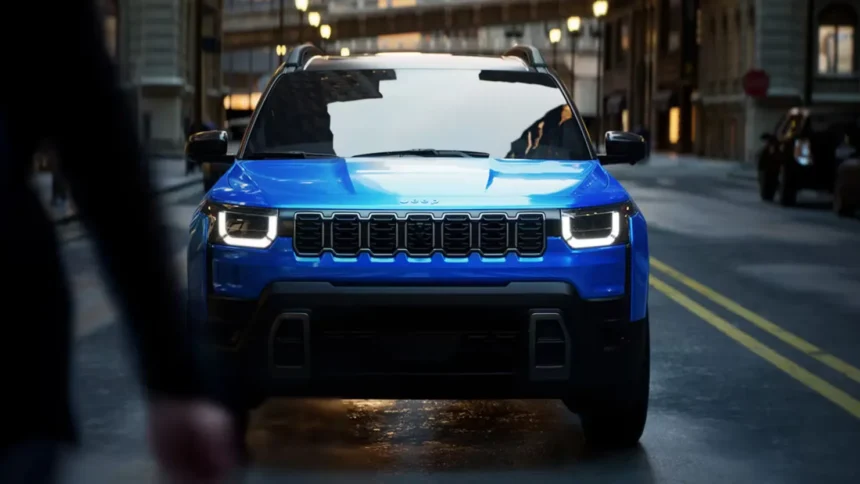
The global automotive industry is entering a new phase of electrification – one driven less by ambitious EV narratives and more by practical technological compromises. Stellantis’ decision to integrate hybrid systems from external suppliers into its newest Jeep models reflects this shift clearly. As NewsTrackerToday observes, automakers are increasingly focusing on solutions that balance efficiency improvements with realistic consumer adoption, particularly in North America where EV demand has grown more slowly than originally projected.
The upcoming Jeep Cherokee hybrid will incorporate a dual-motor hybrid transmission developed by Blue Nexus, a joint venture supported by suppliers closely tied to Toyota’s hybrid ecosystem. At the same time, Stellantis is preparing extended-range electric vehicles (EREV) using electrification technologies from Bosch, the world’s largest automotive components manufacturer. This approach allows the company to accelerate the development of electrified vehicles without committing entirely to the costly process of building every system internally.
According to Sophie Leclerc, technology sector analyst, the increasing reliance on supplier ecosystems highlights a structural change in how the automotive industry develops new technologies. Electrification platforms are becoming more modular, enabling manufacturers to integrate mature solutions from specialized partners rather than reinventing entire architectures. In the view of NewsTrackerToday, this shift could significantly shorten development timelines and reduce the financial risks that accompanied earlier waves of EV investment.
The 2026 Jeep Cherokee hybrid demonstrates the practical impact of this strategy. The model is expected to deliver fuel efficiency of roughly 37 miles per gallon in combined driving conditions, making it the most efficient non-plug-in hybrid Jeep produced for the U.S. market. For a brand historically associated with large SUVs and off-road capability, this level of efficiency signals a notable recalibration of engineering priorities.
Liam Anderson, financial markets analyst, notes that the financial motivations behind such partnerships are equally important. After committing tens of billions of dollars to EV platforms, many automakers are now seeking ways to reduce capital intensity while continuing their electrification efforts. As highlighted in analysis by NewsTrackerToday, sourcing hybrid technologies from experienced suppliers allows companies to control development costs while still responding to changing market demand.
Another important component of Stellantis’ strategy is the adoption of extended-range electric architectures. In these vehicles, the car operates primarily as an electric vehicle while the internal combustion engine functions as a generator that recharges the battery once its capacity is depleted. This configuration combines electric driving characteristics with the flexibility of traditional fuel systems, helping to address the range anxiety that still discourages some consumers from fully electric vehicles.
Market trends reinforce the logic behind this approach. Hybrid vehicles have rapidly expanded their share of U.S. vehicle sales in recent years, while the growth rate of fully electric vehicles has slowed. Consumers increasingly view hybrids as a balanced solution that improves efficiency without requiring major changes in driving habits or reliance on charging infrastructure.
As News Tracker Today concludes, Stellantis’ hybrid strategy reflects a broader recalibration across the automotive sector. Rather than pursuing a rapid and complete transition to fully electric vehicles, manufacturers are increasingly adopting flexible electrification pathways that combine hybrid, extended-range, and battery technologies. If models such as the new Cherokee hybrid and upcoming EREV platforms prove commercially successful, hybrids could become the dominant bridge technology shaping the global automotive market through the end of the decade.