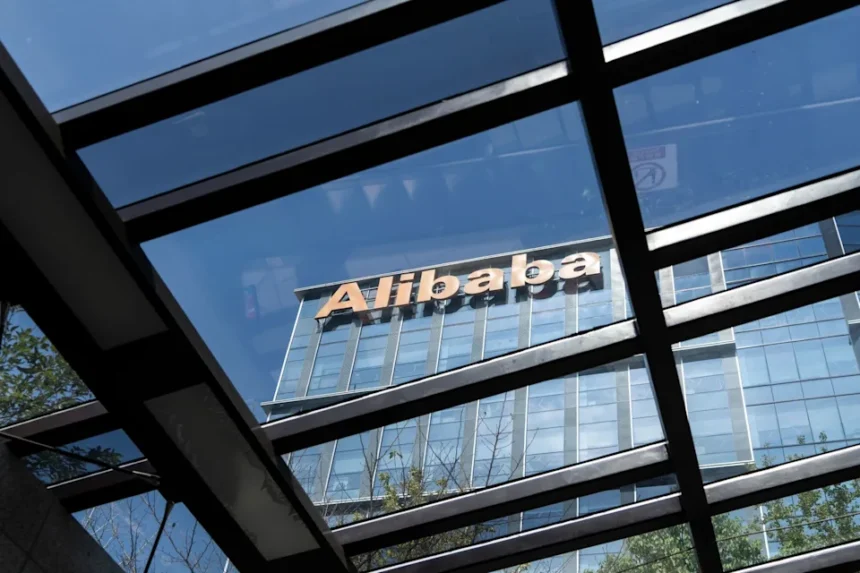
Alibaba is restructuring its artificial intelligence strategy as competition intensifies among Chinese technology companies racing to turn AI innovation into sustainable revenue. NewsTrackerToday notes that the company is creating a new division called Alibaba Token Hub, bringing together its flagship Qwen model research, consumer AI products, and several ecosystem platforms under one structure led directly by CEO Eddie Wu.
The new unit will oversee Qwen research teams, consumer-facing AI services, collaboration platform DingTalk, and Quark-branded devices such as smart glasses. By consolidating these initiatives, Alibaba aims to accelerate cooperation between engineers, designers, and commercial teams. Isabella Moretti, an analyst specializing in corporate strategy and M&A, notes that large technology firms often struggle not because of weak research capabilities but because breakthroughs remain disconnected from product deployment.
The name Token Hub also highlights the company’s economic logic. In modern AI infrastructure, tokens represent the units of computation consumed when models generate responses or perform tasks. Liam Anderson, an expert in financial markets, says structuring a business division around token economics suggests Alibaba views AI primarily as a scalable consumption model rather than a standalone application. NewsTrackerToday notes that the restructuring comes at a sensitive moment for Alibaba’s AI ambitions. The recent departure of Junyang Lin, one of the key architects behind the Qwen model family, raised concerns among developers and investors about leadership continuity within the company’s AI division. By placing the new unit directly under CEO Eddie Wu, Alibaba appears to be reinforcing strategic control over one of its most important growth areas.
Another structural challenge lies in the Chinese AI market itself. Unlike in the United States, where companies such as OpenAI rely heavily on subscription revenue, Chinese consumers have historically been less willing to pay for software services. Ethan Cole, chief economic analyst specializing in macroeconomics and central banks, argues that this forces local companies to embed AI more deeply into existing ecosystems such as e-commerce, payments, and enterprise platforms.
Alibaba appears to be moving in that direction. According to people familiar with the company’s plans, it is preparing a corporate AI agent built on the Qwen model. The tool could integrate services across the Alibaba ecosystem, including Taobao, Alipay, and mapping platform Amap. Sophie Leclerc, a technology sector analyst, explains that agent-based systems represent one of the most commercially promising uses of generative AI because they can automate real-world workflows rather than simply answer questions. News Tracker Today observes that integrating conversational AI with commerce and financial services could significantly shorten the distance between user intent and transaction completion. Instead of moving through multiple apps, users could shift directly from conversation to purchase within a single AI interface.
Competition, however, remains intense. ByteDance’s AI assistant Doubao has rapidly gained users, while Tencent and Baidu continue investing heavily in their own AI ecosystems. These dynamics suggest that success will depend not only on model performance but also on how effectively companies integrate AI with real-world services. NewsTrackerToday therefore views the creation of Alibaba Token Hub as an attempt to transform the company’s AI strategy from fragmented experimentation into a coordinated commercial platform. If the restructuring leads to faster product launches and stronger enterprise adoption, Alibaba could strengthen its position in the next phase of AI-driven digital infrastructure.