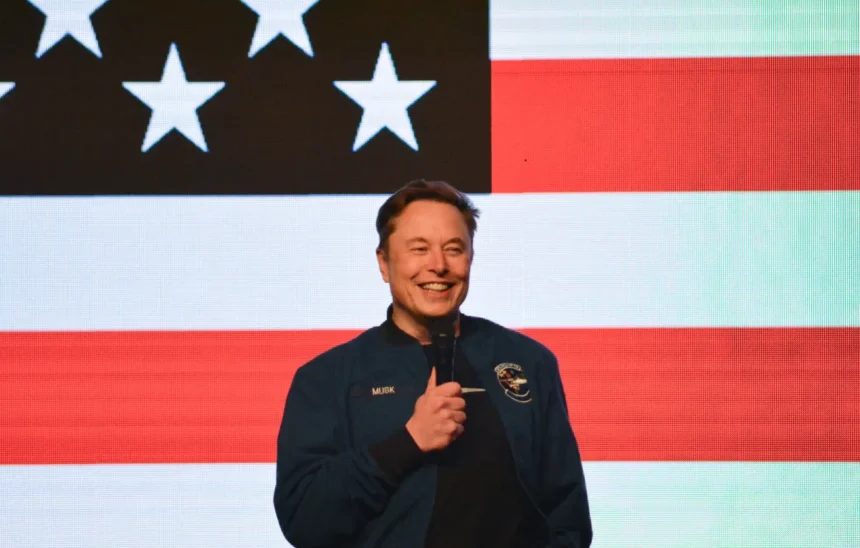
Elon Musk’s proposal to build a large-scale chip manufacturing complex, referred to as “Terafab,” reflects a growing shift among technology leaders toward securing direct control over critical AI infrastructure. The initiative, positioned as a joint effort between Tesla and SpaceX, is driven by concerns that existing semiconductor supply chains are insufficient to support the scale of AI and robotics ambitions within Musk’s ecosystem. As NewsTrackerToday notes, this move signals a broader transition from dependency on external suppliers toward vertically integrated compute strategies.
At a conceptual level, the project reframes semiconductors not as components, but as a foundational resource. Tesla’s expansion into autonomous driving, robotics, and AI training systems, alongside SpaceX’s increasing reliance on computational capacity for satellite networks, has significantly increased demand for advanced chips. Sophie Leclerc, a technology sector observer, argues that this shift reflects a new industry paradigm where access to compute power becomes a primary competitive advantage, comparable to energy or logistics infrastructure in previous technological cycles.
The scale of Musk’s ambitions further underscores this positioning. The stated goal of generating 100–200 gigawatts of compute capacity annually on Earth, with future expansion toward terawatt-scale systems in space, indicates that the focus extends beyond traditional semiconductor output metrics. Rather than thinking in units of chips, the strategy emphasizes total computational throughput. NewsTrackerToday highlights that this framing aligns with the increasing convergence of energy and computation in AI-driven industries.
However, the execution challenges are substantial. Musk does not have direct experience in semiconductor manufacturing at the foundry level, where operational complexity is defined by yield optimization, advanced lithography, and tightly controlled supply chains. Isabella Moretti, an analyst specializing in corporate strategy and M&A, notes that while vertical integration can offer strategic advantages, building a competitive fabrication ecosystem from scratch requires long development cycles and deep technical partnerships.
This is reflected in Tesla’s continued reliance on established manufacturers. Existing agreements with major semiconductor partners demonstrate that, in the near term, external supply remains essential. Liam Anderson, a financial markets expert, points out that such parallel strategies are common in capital-intensive industries: companies invest in internal capabilities while maintaining external sourcing to mitigate risk and ensure continuity.
The competitive context further explains the rationale behind Terafab. As demand for AI chips accelerates globally, supply constraints have become a limiting factor for innovation. Controlling production capacity allows companies not only to secure supply but also to influence development timelines and cost structures. NewsTrackerToday emphasizes that this level of control can be critical in sectors where delays in hardware availability directly impact product deployment and revenue growth.
At the same time, the project carries inherent risks. The capital requirements for advanced semiconductor manufacturing are extremely high, and returns are typically realized over extended periods. There is also the risk of technological misalignment if internal capabilities fail to match the pace of industry leaders. From an operational perspective, scaling such an initiative without established manufacturing expertise introduces uncertainty.
Despite these challenges, the strategic logic remains consistent with Musk’s broader approach. Previous efforts in batteries, launch systems, and infrastructure have followed a similar pattern of internalization to overcome external constraints. News Tracker Today notes that Terafab can be viewed as an extension of this model into the semiconductor domain, where control over production is increasingly tied to long-term competitiveness in AI.
The outcome will depend on several critical factors. NewsTrackerToday identifies three: the ability to secure partnerships and technical expertise, the pace at which internal manufacturing capabilities can be developed, and the extent to which the project can meaningfully reduce reliance on external suppliers. These elements will determine whether Terafab evolves into a functional pillar of Musk’s ecosystem or remains an ambitious but difficult-to-execute vision.