Zoox’s planned expansion into Austin and Miami marks a critical transition as the company moves from controlled pilots toward broader operational scaling. While the geographic growth is notable, the real question is whether Amazon’s autonomous vehicle unit can prove it has a repeatable, commercially viable robotaxi model. As NewsTrackerToday notes, this stage – moving from demonstration to deployment – is where most autonomous strategies face their first real stress test.
The rollout will be gradual. Initial access in both cities will be limited to employees and close networks before expanding through a waitlist-based Explorer program. This controlled approach reduces reputational risk and allows the company to validate performance in new environments before wider exposure. In early-stage mobility systems, first user experience often defines long-term perception.
Zoox has already accumulated meaningful operational data, including hundreds of thousands of passenger trips and a large waitlist. However, the gap with Waymo remains significant. Waymo operates at a much larger commercial scale, delivering hundreds of thousands of paid rides weekly. At this point, Zoox is no longer an experimental player – it is being directly compared to an established market leader.
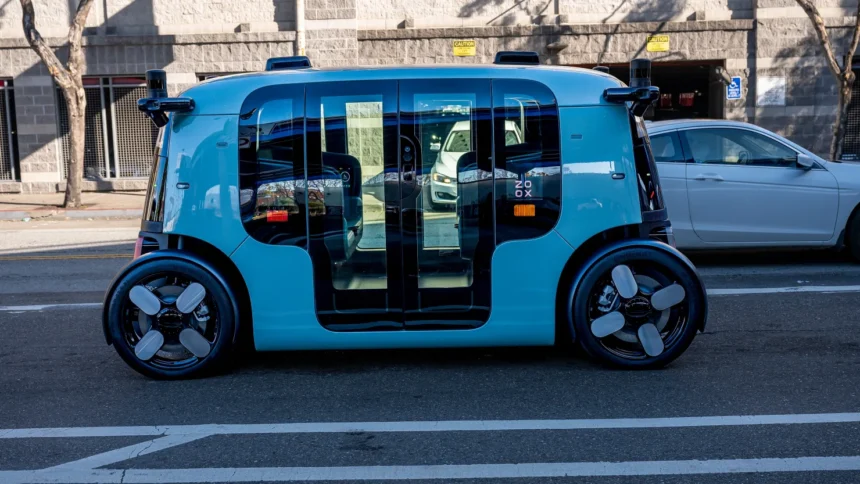
A key differentiator is Zoox’s purpose-built vehicle design. Unlike competitors that adapt existing platforms, Zoox uses fully autonomous, bidirectional vehicles without steering wheels or pedals. While this offers long-term product advantages, it also increases regulatory complexity. Approval from agencies such as the NHTSA remains essential for scaling. NewsTrackerToday emphasizes that without regulatory alignment, even strong technological differentiation can remain commercially limited. At the same time, Zoox is expanding in existing markets. In San Francisco, it is significantly increasing coverage, while in Las Vegas it is targeting high-density, event-driven routes and airport connectivity. This reflects a strategic shift from proving capability to optimizing real demand scenarios – a necessary step for improving utilization and unit economics.
The partnership with Uber further supports this transition. Integration into a major ride-hailing platform provides faster access to demand and operational insights. However, it also introduces a trade-off between accelerated adoption and long-term control over the user relationship. Liam Anderson, NewsTrackerToday financial markets expert, notes that the core challenge now lies in execution. Scaling fleet production, maintaining utilization, and achieving sustainable economics are often more difficult than building the technology itself. This is where many autonomous projects encounter their biggest constraints.
Backed by Amazon, Zoox benefits from long-term capital support, allowing for a more patient scaling strategy. However, this does not eliminate competitive pressure. Waymo’s scale continues to set the benchmark, reinforcing Zoox’s position as a developing challenger rather than a dominant player.
The next phase will depend on how effectively Zoox converts pilots into paid services, expands its fleet, and navigates regulatory approvals. News Tracker Today highlights that success will be determined not by technological ambition alone, but by the company’s ability to execute consistently in real-world conditions and build a scalable operational model.