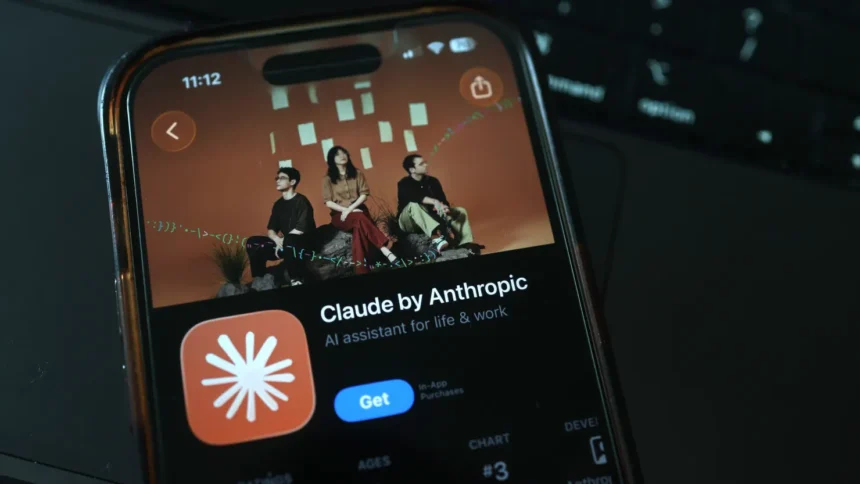
Claude’s sudden surge to the top of the U.S. App Store rankings marks more than a viral moment – it highlights how politics, ethics, and AI competition now intersect in real time. Just days after political pressure mounted around Anthropic’s government positioning, its chatbot climbed to No. 1 among free apps in the United States. As NewsTrackerToday emphasizes, in today’s AI race, headlines convert into downloads almost instantly.
The spike followed attempts by officials to limit the use of Anthropic’s technology within certain government and defense-related environments. That pressure framed the company as either a principled actor refusing controversial deployments or a supplier misaligned with federal priorities – depending on perspective. Liam Anderson, financial markets expert, notes that “controversy often accelerates consumer visibility faster than paid marketing ever could.” In this case, political tension amplified brand awareness at scale.
Download growth does not automatically translate into durable market share. Anthropic reported that free users increased more than 60% since January, daily signups tripled compared with late last year, and paid subscriptions more than doubled year-to-date. Those figures signal strong momentum. However, sustained success depends on retention, not installation velocity. As NewsTrackerToday observes, many AI apps experience short-term surges during news cycles but struggle to convert curiosity into long-term habit.
The competitive backdrop intensifies the stakes. ChatGPT continues to rank near the top of app charts and maintains a dominant global user base. OpenAI recently reinforced its institutional positioning by expanding agreements with government-related entities and large enterprise partners. Daniel Wu, geopolitics and technology analyst, argues that “AI competition increasingly hinges on regulatory alignment and procurement trust, not just model performance.” That shift pushes companies to balance ethical positioning with commercial pragmatism.
Anthropic’s brand narrative centers on safety boundaries – particularly around surveillance applications and fully autonomous weapons. That positioning differentiates Claude from some competitors and resonates with segments of users concerned about responsible AI development. Yet it also creates friction in defense and national security procurement environments. NewsTrackerToday highlights that when AI providers draw strict red lines, they may strengthen consumer trust while narrowing certain high-value institutional channels.
The broader AI ecosystem continues to expand rapidly. Enterprise adoption of coding assistants, workflow automation, and research copilots accelerates across consulting firms and corporate IT departments. Anthropic has gained traction in programming use cases and corporate knowledge tasks, positioning Claude as a productivity-oriented alternative rather than purely a conversational chatbot. The question now centers on whether consumer enthusiasm can reinforce that enterprise momentum.
Ultimately, this episode illustrates a structural evolution in the AI market. Public controversy can boost visibility overnight, but governance credibility and sustained product value determine long-term leadership. As News Tracker Today assesses, Anthropic’s next phase depends on converting political spotlight into durable engagement – while navigating a competitive landscape where regulatory alignment, enterprise partnerships, and user trust define the true battleground of generative AI.