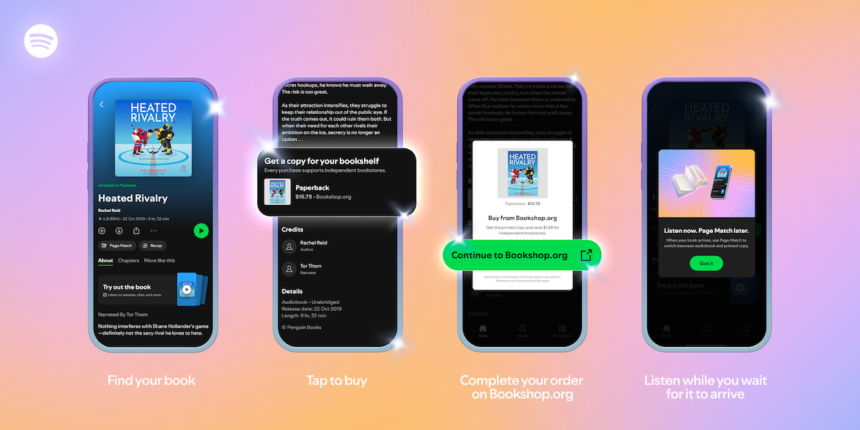
A quiet shift in digital media strategy is unfolding as Spotify moves beyond streaming and into physical commerce, with NewsTrackerToday highlighting how the company now enables users in the U.S. and U.K. to purchase printed books directly through its app. The feature, launched in partnership with Bookshop.org, integrates retail into audiobook pages, signaling a deeper push to expand user engagement beyond listening.
The mechanics are intentionally simple. A “Get a copy for your bookshelf” button appears alongside audiobook listings, redirecting users to Bookshop.org for transaction handling. Spotify avoids inventory and logistics complexity, instead leveraging an affiliate-style model that monetizes discovery without disrupting its core platform. This approach mirrors broader platform economics trends, where distribution power becomes more valuable than ownership of physical goods.
Sophie Leclerc, a technology sector specialist, views this as a structural evolution rather than a feature update. The shift positions Spotify as a hybrid ecosystem – not just a streaming service, but a layered content marketplace. NewsTrackerToday emphasizes that this move aligns with a wider industry pattern, where platforms increasingly blur the boundaries between content consumption and commerce to extend lifetime user value.
The timing also reflects internal pressures. Spotify’s recent price increases across major markets and its reported 751 million monthly active users point to a scaling challenge: growth alone no longer guarantees profitability. By embedding commerce directly into user flows, the company taps into high-intent moments – when a listener is already engaged with a title – converting attention into revenue more efficiently. NewsTrackerToday draws attention to how this mirrors strategies seen in video and social platforms, where frictionless purchasing becomes a core monetization lever.
Beyond commerce, Spotify is reinforcing its audiobook ecosystem through product innovation. The expansion of “Page Match” to over 30 languages strengthens cross-format integration, allowing users to transition seamlessly between physical or digital reading and audio consumption. Early engagement metrics – including a 55% increase in listening time among users of the feature – suggest that hybrid consumption models drive deeper platform stickiness. Meanwhile, Audiobook Recaps and regional chart rollouts further reduce friction and improve discoverability, key factors in competing with established players in the book market.
Liam Anderson, who specializes in financial markets, interprets these developments as part of a broader margin strategy. Instead of relying solely on subscription revenue, Spotify builds multiple monetization layers around a single user base – a model that can stabilize earnings in volatile consumer spending environments. News Tracker Today frames this as a transition from scale-driven growth to efficiency-driven expansion, where each feature must contribute measurable economic value.
What emerges is a platform redefining its identity. By combining streaming, discovery, and commerce within a unified interface, Spotify challenges traditional booksellers without directly replicating their operational model. NewsTrackerToday captures this shift as a calculated move toward ecosystem dominance, where controlling the user journey – from discovery to purchase – becomes the central competitive advantage.